Guide · HOA paint colors · Sun City Grand
Sun City Grand Exterior Paint Rules Explained
By the Orange Coatings team · Published
In Sun City Grand you need Architectural Review Committee (ARC) approval before repainting your home, even if you keep the exact color scheme you have now, and the new scheme must come from the approved list for your model series, 9100 or 9200. Only touch-up painting of part of the house in the existing colors skips preapproval.
The rules come from The Grand's Residential Design Guidelines, dated May 2026, and the approved schemes are posted in the Dunn-Edwards Color Ark Pro library. Here is how the pieces fit together for a full exterior repaint in this Surprise active-adult community.
| Who reviews | Architectural Review Committee, through the Standards Office at 19726 N. Remington Drive |
|---|---|
| Same-scheme repaint | Needs ARC approval |
| Partial touch-ups | No preapproval if you use the existing scheme |
| Approved schemes | 9100 Series and 9200 Series, posted on Dunn-Edwards Color Ark Pro |
| Typical response | Within 30 days; work due within 90 days of approval unless the letter says otherwise |
Why a same-color repaint still needs approval
Many West Valley associations let owners repaint existing colors without paperwork. The Grand does not. Its guidelines require ARC approval before you repaint the house or casita in the existing scheme or switch to a different permitted one. The only exception is maintenance: touching up a portion of the home in its existing colors.
The application also lets the Standards Office confirm that your current scheme is still allowed, which matters because several schemes have been retired.
9100 vs 9200 series: which list is yours
Every home in The Grand is designated as a 9100 or 9200 model series, and it must be repainted from the permitted schemes for that series. Your sales paperwork or the Standards Office can tell you which one you have.
The two series are built differently. A 9100 scheme on the Dunn-Edwards page lists a body, trim and accent color; Scheme 1, for example, pairs DE6213 Fine Grain with DEC770 Drifting and DEC755 Cocoa. A 9200 scheme adds a secondary base, so it has four colors: Scheme 1 there is Vintage Ephemera, Baked Potato, Missing Link and Downing to Earth. If you pick a 9200 scheme and want to drop the trim or accent color in favor of a base color, that change needs ARC approval too.
Schemes you can no longer choose
Six schemes have been removed: 91-23, 91-24, 92-25, 92-30, 92-31 and 92-33. They cannot be used for a new scheme or for repainting the existing one. If your house wears one of them today, you are not forced to repaint early, but the next full repaint has to move to a permitted scheme.
That is why gaps appear in the numbering on the posted lists. Do not pick a scheme from an old printout without checking it against the current guidelines.
Where each color goes: the Paint Placement Guide
Colors have to land in the locations shown on the Paint Placement Guide for your specific model and elevation, viewable online or at the Standards Office. A few placement rules are written into the guidelines directly.
- Front entry doors on the house and casita may be any color in your scheme; wood doors may be stained a natural color.
- Overhead garage doors take the color the scheme specifies for your model, or the Color #1 base.
- The garage side door and doors out of a kitchen, bedroom or den take the Color #1 base.
- Front courtyard gates, rear patio gates and gates in the wall of a walled-in lot may be any scheme color or black.
- Roof tiles may not be painted, and a casita is painted in the same scheme as the main house.
Walls, wall caps and mailboxes
Stucco walls that are not part of the house, including courtyard, rear patio, equipment screen, planter and landscape walls, get the Color #1 base. The inside face of a rear patio wall can take any color in the scheme. Wall caps may be the base or Color #2, which is the trim color in a 9100 scheme and the secondary base in a 9200 scheme.
Common-area walls along main roads, trails, culverts and retention basins belong to the association and may not be painted by owners at all. Stucco mailboxes have their own spec: a lace-textured body in your base color, with the precast cap and split-face block in either the community standard color or your trim color.
The neighbor rule and the whole-lot palette
Your scheme may not match either of the two homes immediately next to yours. The guidelines also ask that the full exterior read as one palette, so the committee considers your roof tile, stone veneer, gravel ground cover, pavers and any coating on the driveway, walkways or patio alongside the new paint.
That makes order of work matter. If you plan a driveway or patio coating in the same year, choose its color with the house scheme in hand and include both in your thinking before you apply.
Applying to the ARC, step by step
- Confirm your model series (9100 or 9200) and pull up the Paint Placement Guide for your model.
- Choose a permitted scheme and check it against the two homes beside you.
- Complete the ARC application for exterior paint and turn it in to the Standards Office.
- Expect a response within about 30 days, returned in person, by mail or by email, signed by at least two ARC members.
- If the request is disapproved, resubmit with changes or file an appeal form within ten days of notice.
- Finish the work within 90 days of the approval letter unless the approval sets a different deadline, and request an extension in writing if materials or labor delay you.
How we paint a home in The Grand
We help you identify your series and scheme, list every Dunn-Edwards color with its closest Sherwin-Williams match, and mark which surfaces take Color #1, #2, #3 and #4 according to your placement guide. You get that as a written color sheet for the application and for our crew.
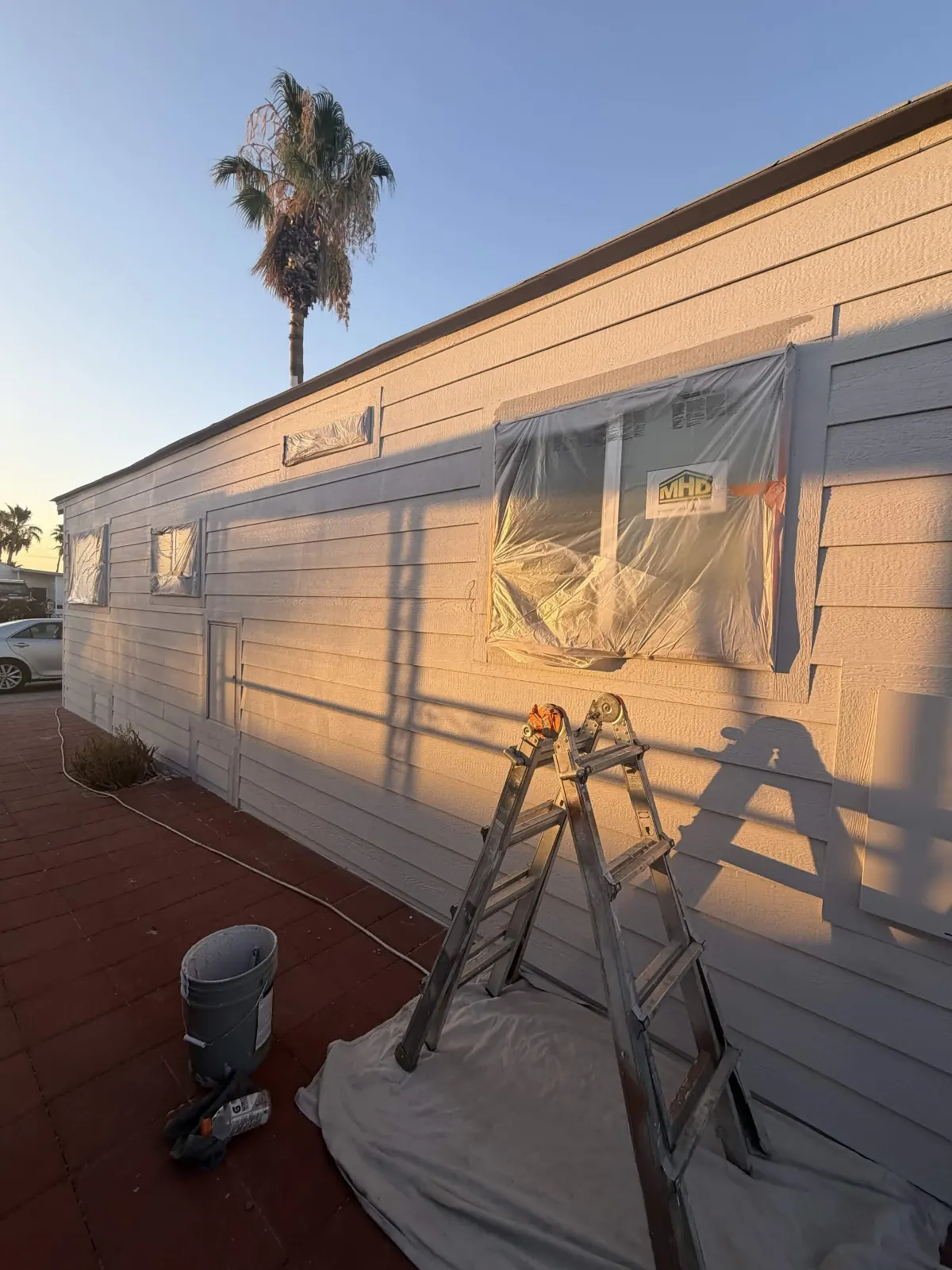
Many homes here date from 1996 to 2005, so a repaint often follows years of sun on the original coat. We check for chalking and hairline cracks, prime bare or patched stucco with Loxon, and finish with two coats of Sherwin-Williams Emerald Exterior.
Frequently asked questions
- Is ARC approval required for a same-color repaint in The Grand?
- Yes. The Grand's guidelines require ARC approval for a repaint in the existing scheme as well as for a new one. Only partial touch-ups in the existing colors are exempt.
- How do I know if my home is a 9100 or 9200 series?
- Each home is designated as one or the other. Check your purchase records or ask the Standards Office, which also has the Paint Placement Guide for your model.
- Which Sun City Grand paint schemes were removed?
- Schemes 91-23, 91-24, 92-25, 92-30, 92-31 and 92-33. Homes already painted in one of them can keep it until the next repaint.
- What color does the garage door have to be in Sun City Grand?
- Either the color your scheme specifies for your model or the scheme's Color #1 base. White-looking colors and unpainted garage doors are not permitted.
- Can I paint the wall along the street behind my house?
- Not if it is a common-area wall. Walls along main roads, trails, culverts and retention basins are maintained by the association and owners may not paint or alter them.
- Can you use Sherwin-Williams paint for a Dunn-Edwards scheme?
- Yes, we cross-match every Dunn-Edwards color in your scheme to the nearest Sherwin-Williams color. Confirm with the Standards Office that a cross-matched color is acceptable before filing.
Related
Sources
- The Grand's Residential Design Guidelines (May 2026)
- Sun City Grand Community Association: Governing Documents
- Dunn-Edwards Color Ark Pro: Sun City Grand 9100 Series
- Dunn-Edwards Color Ark Pro: Sun City Grand 9200 Series
- Dunn-Edwards Color Ark Pro: Sun City Grand community repaint guidelines
- Surprise, Arizona (Wikipedia)