Guide · Exterior color
Two-Tone and Three-Tone Exterior Schemes for Stucco
By the Orange Coatings team · Published
A two-tone stucco scheme uses one color for the body and a second for trim features such as fascia, window pop-outs, foam bands and columns; a three-tone scheme adds a third, usually deeper accent for the front door, shutters or iron. In Arizona the combinations that last and look right keep the body light to mid-tone, set the trim clearly lighter or darker than the body, and save the strongest color for small areas.
Most West Valley HOAs approve exterior colors as a set, so the scheme is chosen as a unit rather than one color at a time. Below is where each color goes on a typical stucco house, how much contrast to aim for, and some starting pairings.
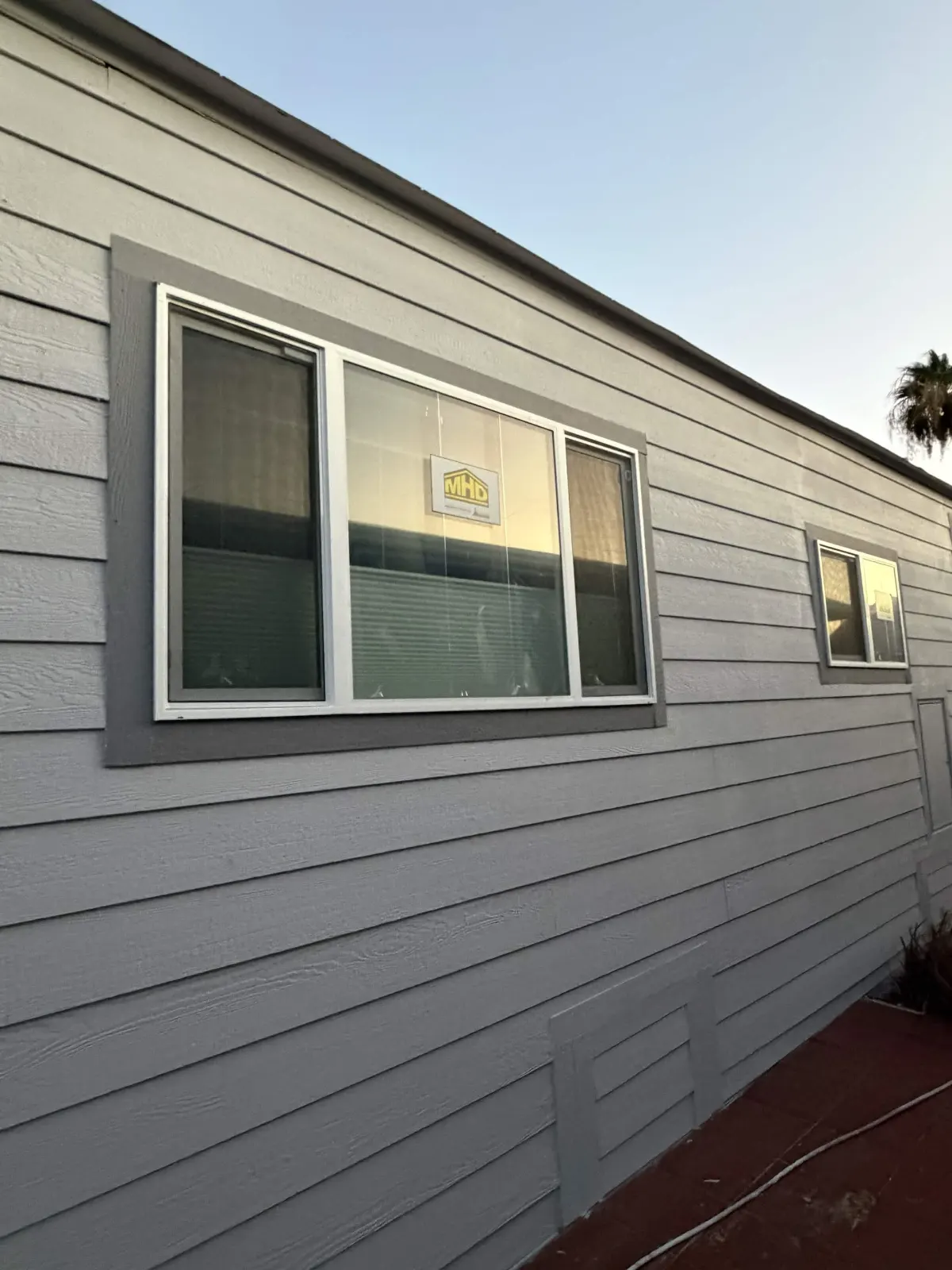
Where each color goes on a stucco house
A two-tone house simply merges the trim and accent roles: the door, shutters and fascia share one color, or the door is painted the trim color.
- Body: the large stucco wall areas, plus the garage door on most schemes, and utility boxes, vents and downspouts on the stucco so they disappear.
- Trim: fascia boards, window and door surrounds or pop-outs, foam trim bands, columns, parapet caps and sometimes the garage door frame.
- Accent: the front door, shutters, decorative tile niches, gates and iron railings. On some homes, a recessed entry wall or a single tower element.
- Roof tile and stone veneer: not painted, but they are part of the scheme and should guide every choice above.
How much contrast looks right
Contrast between body and trim is what makes a two-tone house read as intentional. Too little and the trim looks like a slightly dirty version of the body; too much and the house looks busy and the stucco texture gets lost. A useful way to judge it is Light Reflectance Value, the 0 to 100 number Sherwin-Williams prints on each chip. A gap of roughly 15 to 25 points between body and trim usually reads clearly from the street without looking harsh.
Desert light pushes the eye toward more contrast than you expect. Bright overhead sun flattens color, so pairs that look strong on a chip indoors can look washed out on the wall at noon.
Two-tone pairings to start from
The LRV numbers below are calculated from Sherwin-Williams color data and are approximate. Treat these as starting points to sample, not finished schemes, and check them against your roof tile.
- Warm and classic: SW 7036 Accessible Beige body (around 58) with SW 7038 Tony Taupe trim (around 37).
- Soft greige: SW 7029 Agreeable Gray body (around 60) with SW 7017 Dorian Gray trim (around 39).
- Desert sand: SW 6106 Kilim Beige body (around 57) with SW 6108 Latte trim (around 38).
- Reversed scheme with light trim: SW 6150 Universal Khaki body (around 41) with SW 6126 Navajo White trim (around 73).
- Cool gray: SW 7015 Repose Gray body (around 58) with SW 7019 Gauntlet Gray trim (around 17), for a crisper, more modern look.
Adding a third color
The third color is where personality goes, and because it covers so little area it can be deeper or more saturated than you would ever use on a wall. Deep bronzes and charcoals such as SW 7048 Urbane Bronze or SW 7069 Iron Ore tie in with dark iron and window frames. Muted greens such as SW 6208 Pewter Green or SW 6207 Retreat sit well against tan stucco and desert landscaping. A deep blue like SW 6244 Naval works against warm grays and whites.
Keep the accent to one or two features. A front door, its sidelights and the shutters in one accent color is plenty on most houses.
Where the color changes should land
- Change colors at an inside corner, a trim edge or a change in plane, never in the middle of a flat wall.
- Paint pop-outs and bands as complete shapes, including their returns and undersides.
- Keep a single wall plane one color from grade to fascia unless there is an architectural break.
- Match downspouts, vents, meter boxes and conduit to whatever surface they sit on.
- Decide the garage door up front: body color makes it recede, trim color makes it a feature.
Sheen and texture on stucco
Flat or low-sheen finishes suit stucco bodies because they hide the variations in sand texture and patching that a shinier finish would highlight. Trim and doors can go one step glossier, which sharpens the color break and makes those smaller surfaces easier to wipe clean. On a two-tone job, keeping the sheens consistent across all trim pieces matters as much as the color itself.
Sampling in Arizona light
- Paint large samples of each color, side by side, on a sunny wall and a shaded wall.
- Look at them in early morning, at midday and in late afternoon, when the light turns warm.
- Stand at the street, not at the wall; that is the view your neighbors and HOA see.
- Hold samples next to the roof tile, stone and pavers before deciding.
HOA approval and how we help
Many communities publish pre-approved schemes with the body, trim and accent already paired, while others approve each color separately. Either way, submit the full set at once with Sherwin-Williams color numbers. Our crews spray and back-roll two coats of Emerald Exterior on stucco and cut the color lines by hand, and at the estimate we can pull your HOA palette and help you match colors given in another brand to Sherwin-Williams equivalents.
Frequently asked questions
- Does a two-tone exterior cost more than a single color?
- Usually a little, because every color break needs masking and hand cutting. The difference depends on how much trim the house has, so ask for the scheme to be priced on the written estimate.
- Should the trim be lighter or darker than the body?
- Either works. Darker trim frames a light body and is the more common choice in the West Valley; lighter trim on a mid-tone body gives a softer, more traditional look.
- What color should the garage door be on a two-tone stucco house?
- Most often the body color, so the door blends in and the entry gets the attention. Painting it the trim color makes it a feature, which suits some homes.
- How many colors are too many for a stucco house?
- Three is plenty for most homes, and many look best with two. More than that tends to chop up the walls and look busy from the street.
- Can I use a three-tone scheme if my HOA only lists two colors?
- Ask your HOA before painting. Many allow an accent door color from a separate list, but some do not, and written approval should come first.
- Will a dark trim color fade faster than the body?
- Dark colors absorb more heat and tend to show fading sooner, especially on fascia facing south or west. Trim is a small area, so touching it up between full repaints is practical.