Paint color · Sherwin-Williams
Navajo White (SW 6126): The Creamy Off-White in Arizona Light
Published
Navajo White (SW 6126) is a warm, creamy off-white with a soft yellow-peach glow, deeper than a clean white but much lighter than a beige. Calculated from its RGB values, its LRV comes out at about 73, so it reflects a lot of sun while avoiding the hard glare of a bright white on a stucco wall.
It works as a light body color, as trim on tan and brown houses, and as a warm interior white. The catch is that cream can look either cozy or dated depending on what surrounds it, so this page spends time on context and testing.
Color swatch: Navajo White SW 6126, #E9DCC6
| Color | Navajo White |
|---|---|
| Code | SW 6126 |
| Hex | #E9DCC6 |
| RGB | 233, 220, 198 |
| LRV | About 73 (calculated from the RGB values, not Sherwin-Williams' published figure) |
| Family | Warm, creamy off-white |
Is Navajo White a white or a cream?
On its own it looks white. Beside a true white like Extra White (SW 7006) it immediately reads as cream. The RGB values (233, 220, 198) drop off toward blue, which is where the warm, slightly peach character comes from.
That makes it a forgiving choice when you want a white that does not feel cold, but a poor choice if you want trim that looks crisp next to gray. In a mostly gray scheme it will look yellow by comparison.
Navajo White on sunlit stucco
Under the flat white light of a summer noon, it looks close to plain white from across the street. The cream becomes clearer in the morning and the late afternoon, when the sun is lower and warmer, and a west wall may look almost butter-colored at sunset.
On shaded walls and soffits it can turn a touch beige. Because it is light, it shows dust, irrigation overspray and red dirt splash at the base of walls more than a mid-tone tan, so think about how close sprinklers and bare soil are to the house.
Navajo White in north-facing and sunny rooms
North light keeps it soft and slightly muted, and it avoids the gray, shadowy look a cool white can take on in those rooms. In a south or west room with strong afternoon sun the walls can look quite warm, almost ivory.
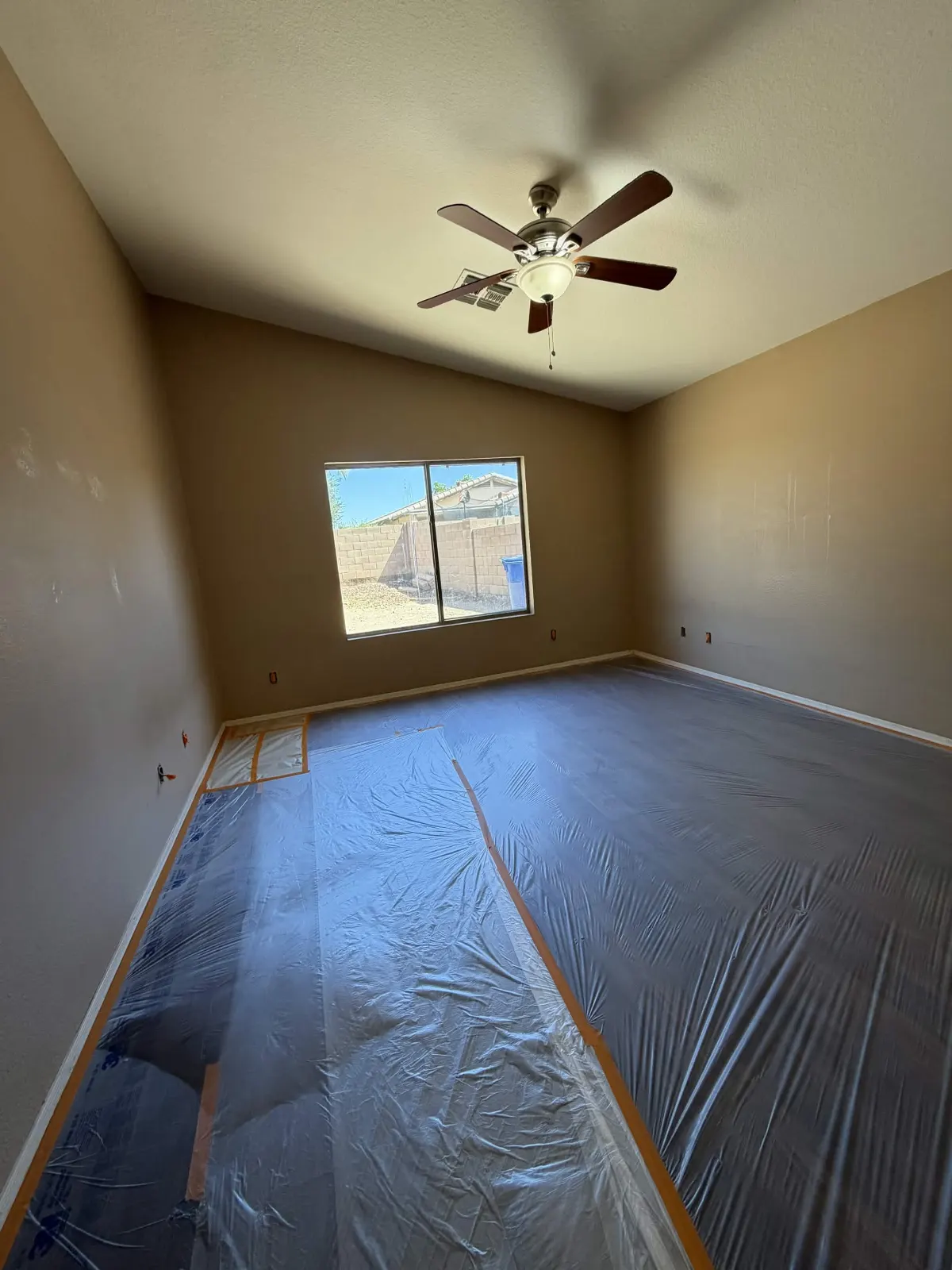
Inside, it suits bedrooms, dens and formal living rooms with warm wood or terracotta tile. It also works as trim and doors when the walls are a light tan, giving a soft step of contrast instead of a sharp line.
Roles Navajo White handles well
- Body color on a Southwest or territorial-style home where a warm white suits the architecture
- Trim, fascia and window surrounds on a tan body such as Macadamia (SW 6142) or Softer Tan (SW 6141)
- Interior walls and trim together in one color for a calm, low-contrast look
- Cabinets in a warm kitchen where stark white would clash with travertine or wood
Navajo White on Southwest and territorial homes
Warm whites suit the flat roofs, parapets and rounded corners of Pueblo Revival and territorial-style houses, where a cold white can look like primer. Navajo White softens those simple shapes and lets dark wood vigas, iron gates and clay pots stand out.
On a newer tract home with a gray concrete roof, the same color can look out of step, so the roof and hardscape should drive the decision more than the style name of the color.
What goes with Navajo White
- Creamy (SW 7012), a coordinating color, as a slightly lighter trim or ceiling color
- Softer Tan (SW 6141) or Macadamia (SW 6142) as a body color when Navajo White becomes the trim
- Urbane Bronze (SW 7048) for a front door, garage door trim or light fixtures
- Avoid pairing it with cool grays; the contrast makes the cream look yellow
LRV of about 73: heat and fade behavior
We calculate an LRV of about 73 from the RGB values; Sherwin-Williams publishes its own figure on the color page. At that level the wall reflects nearly three-quarters of visible light, so sun-facing walls absorb less heat than they would in a tan or gray.
Fading on an off-white is mostly invisible. What you notice instead is chalking and dirt, which a gentle wash can remove. Premium exterior paint helps here because it resists chalking better than economy paint.
Sheen and product for Navajo White
On stucco we use Sherwin-Williams Emerald Exterior in a flat or low sheen, over Loxon masonry primer where the stucco is bare or patched, with two coats sprayed and back-rolled. On trim and doors, satin or semi-gloss makes cleaning easier and gives a soft sheen line against the body.
Indoors we use low-VOC Emerald Interior. A cream wall in eggshell looks warm and even; on trim and cabinets a semi-gloss reflects more light and reads a shade whiter.
Testing Navajo White without surprises
- Compare a sample board against a white sheet of printer paper to see how creamy it really is.
- Put it beside your roof tile, garage door and any stone veneer, since those set its context.
- View it on the sunniest wall at noon and again at dusk.
- If an HOA governs your exterior, submit the color and wait for written approval before painting.
Frequently asked questions
- Does Navajo White look yellow?
- It can, depending on its neighbors. Next to cool grays or bright white it looks yellow-cream; next to tans and warm wood it simply looks like a soft white.
- Is Navajo White good for trim?
- It is a good trim color on tan, beige and brown houses, where it gives gentle contrast. On a gray house it will look out of place, and a cleaner white is usually better.
- Does Navajo White make a house look dated?
- Creamy whites were very common on Arizona homes, so on the wrong house it can read as an older palette. Paired with deeper bronze or black accents and updated fixtures, it looks intentional and warm.
- Is Navajo White a good ceiling color?
- In a room with warm walls it works well and keeps the ceiling from looking stark. If your walls are gray, use a cooler white overhead instead.
- What is the difference between Navajo White and Creamy?
- Creamy (SW 7012) is lighter and slightly cleaner, while Navajo White is deeper and more peach-cream. Sherwin-Williams lists Creamy as a coordinating color, so the two can be used together.
- Will Navajo White show dirt on an exterior?
- More than a mid-tone does. Light colors show dust and sprinkler marks near the ground, so keep irrigation off the walls and plan for an occasional rinse.
Related
- All paint colors
- Natural Linen (SW 9109)
- Sand Dollar (SW 6099)
- Residential exterior painting
- Residential interior painting
- Paints and products we use
- How often to repaint in Arizona
- Marshmallow (SW 7001): A Cozy Warm White in Arizona Light
- Toque White (SW 7003): Soft Warm Off-White for Walls and Trim
- Natural Choice (SW 7011): An Earthy Off-White for Desert Homes