Paint color · Sherwin-Williams
Macadamia (SW 6142): A Golden Mid-Tone Tan for Stucco
Published
Macadamia (SW 6142) is a mid-tone tan with a golden, slightly orange warmth, deep enough to give a house real color and light enough to avoid the heat load of a brown. Worked out from its RGB values, its LRV is about 49, right in the middle of the scale.
It is a classic desert body color, especially paired with a creamy trim. The things to watch are how gold it turns in late sun and how it looks next to red or orange roof tile, both covered below.
Color swatch: Macadamia SW 6142, #CCB79B
| Color | Macadamia |
|---|---|
| Code | SW 6142 |
| Hex | #CCB79B |
| RGB | 204, 183, 155 |
| LRV | About 49 (calculated from the RGB values, not Sherwin-Williams' published figure) |
| Family | Mid-tone warm tan with a golden lean |
Macadamia's undertone: golden, not pink
Its RGB values (204, 183, 155) step down evenly from red to blue, a pattern that gives a golden tan instead of a rosy one. Some people describe it as a warm sand or a light caramel.
Compared with a greige, it has far less gray, so it looks more saturated and more clearly warm. That is an advantage on a Spanish or Tuscan-style house and a drawback if you want a cool, modern look.
How Macadamia reads on stucco in the sun
Midday sun pushes it lighter, toward a pale wheat color, so a house painted Macadamia rarely looks as deep as the chip. In the golden hour the orange side wakes up, and a west elevation can look noticeably more amber than the east side of the same house.
Shade deepens it into a soft caramel, which gives good definition around covered entries and pop-outs. With brown concrete tile it is a comfortable match; with orange or red clay tile, sample it at full size, because the two warm tones can either harmonize or compete.
Using Macadamia indoors
In a north-facing room it holds its tan color and does not go gray, which is helpful in rooms that get no direct sun. Under warm incandescent or 2700K bulbs it can lean gold or orange, so check it at night before painting a whole room.
It suits dens, offices and dining rooms, and works as an accent wall behind a fireplace or bookcase. In small rooms with little light, a lighter tan from the same family usually feels more open.
Where Macadamia works
- Main body color on a stucco home with a warm, traditional style
- Deeper color on pop-outs, columns or a second story above a lighter body
- Garage door matched to the body to keep the front of the house quiet
- Interior accent walls and cozy rooms like a study or media room
Macadamia next to desert landscaping
Gold-toned tans sit well beside decomposed granite in tan or gold shades, buff flagstone and the warm bark of mesquite and palo verde. With gray or blue-gray rock landscaping, the contrast makes Macadamia look more orange, so bring a sample board out to the yard as well as to the wall.
Brown-blend pavers and warm travertine around a pool usually look intentional next to it. Cool gray pavers are the combination we would test most carefully.
Pairings for Macadamia
- Navajo White (SW 6126) or Creamy (SW 7012) for trim and fascia that stay warm
- Softer Tan (SW 6141) as the lighter body in a two-tone scheme with Macadamia on the accents
- Urbane Bronze (SW 7048) on the front door, railings and light fixtures
- Tricorn Black (SW 6258) for a sharper, more modern door or shutters
Heat and fading at an LRV of about 49
LRV measures how much visible light a color reflects, from 0 to 100. Our number of about 49 comes from the RGB values, not from Sherwin-Williams' published figure, but it places Macadamia in the mid-range: a sunny wall in this color will run warmer than one in a light beige, though far cooler than a dark brown.
Mid-tone warm colors do show fading on south and west walls over the years, usually as a lighter, chalkier band compared with shaded walls. A premium exterior paint and good prep slow that down, and touching up or repainting the worst elevations first is a common approach.
Sheen and the system we apply
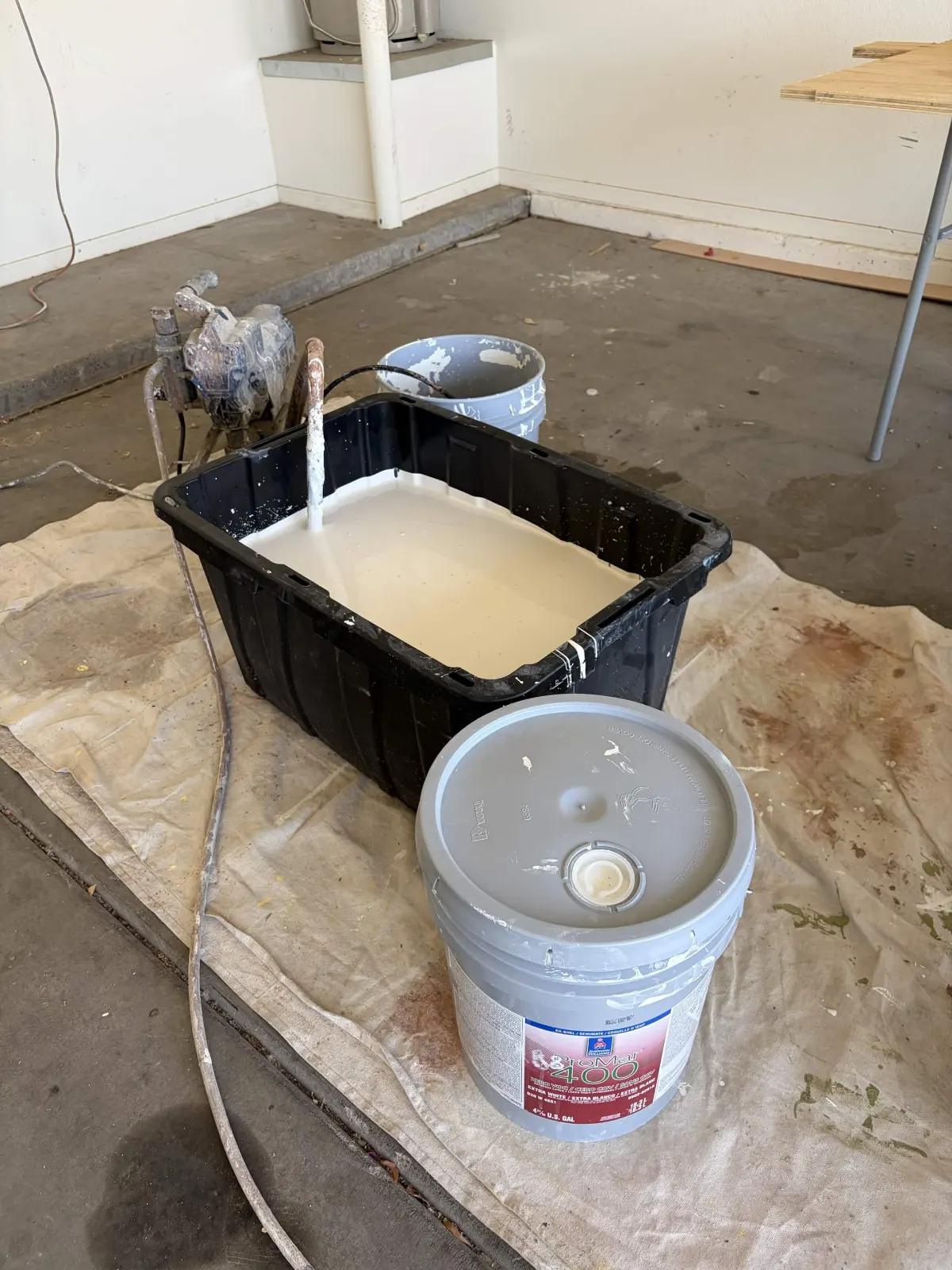
We use Sherwin-Williams Emerald Exterior on stucco, with Loxon masonry primer over bare or patched areas, and two coats sprayed and back-rolled so the color is even in every pocket of the texture. A flat or low-sheen body keeps a mid-tone from showing roller and patch marks.
For interiors we use Emerald Interior, which is low-VOC. Eggshell is a good wall sheen for a warm tan; satin is better in kitchens and baths.
How to sample Macadamia
- Paint a board at least two feet square with two coats.
- Tape it against the stucco near your roof tile and garage door.
- Compare it on the sunniest wall at noon and at sunset, when the gold shows most.
- Ask your HOA whether Macadamia is on the approved palette, and get approval in writing before painting.
Frequently asked questions
- Is Macadamia a beige or a tan?
- It is a mid-tone tan with a golden warmth. It is deeper and more saturated than most beiges, so it gives a house noticeable color.
- Does Macadamia look orange?
- In late-afternoon sun or under warm bulbs it can lean orange-gold. In midday light and on shaded walls it reads as a warm sand color.
- What trim color goes with Macadamia?
- Warm whites such as Navajo White (SW 6126) or Creamy (SW 7012) suit it best. A cool, bright white can make the body look more orange by contrast.
- Will Macadamia make my house hotter than a lighter color?
- Somewhat. With an LRV of about 49 it absorbs more sunlight than a light beige, but it is still a mid-tone, far from the heat gain of dark browns and charcoals.
- Is Macadamia a good garage door color?
- If the body is Macadamia, matching the garage door keeps the facade calm. A darker door draws the eye to the garage, which many homeowners would rather avoid.
- Can Macadamia go in a north-facing room?
- Yes. It keeps its warmth in cool north light instead of going gray. Just check it at night under your bulbs, since warm lighting can push it toward gold.