Paint color · Sherwin-Williams
Canvas Tan (SW 7531) on Desert Stucco and Interiors
Published
Canvas Tan (SW 7531) is a light tan with a quiet khaki edge: warmer than a greige, less rosy than many beiges, and easy to pair with desert landscaping. Its LRV is about 65 when calculated from the RGB values, which keeps it in the light range that holds up well on sunny Arizona stucco.
We think of it as a color that blends a house into gravel, granite and native plants rather than making it stand out. This page covers its undertone, how sun and shade change it, the roles it suits, and how to sample it properly.
Color swatch: Canvas Tan SW 7531, #DCD1BF
| Color | Canvas Tan |
|---|---|
| Code | SW 7531 |
| Hex | #DCD1BF |
| RGB | 220, 209, 191 |
| LRV | About 65 (calculated from the RGB values, not Sherwin-Williams' published figure) |
| Family | Light tan with a slight khaki, greige lean |
Canvas Tan's undertone, explained plainly
The RGB numbers (220, 209, 191) show red and green close together with blue lower, which is why it reads as a sandy tan rather than a pink beige. Many people see a slight yellow-green, khaki quality, especially when it sits next to cooler grays.
Placed next to a pinker beige, it looks more neutral and a little earthier. Placed next to bright white trim, the tan becomes more obvious. That shift is normal for a light neutral, and it is why we always judge it on the actual house rather than on a small chip.
In strong sun on stucco
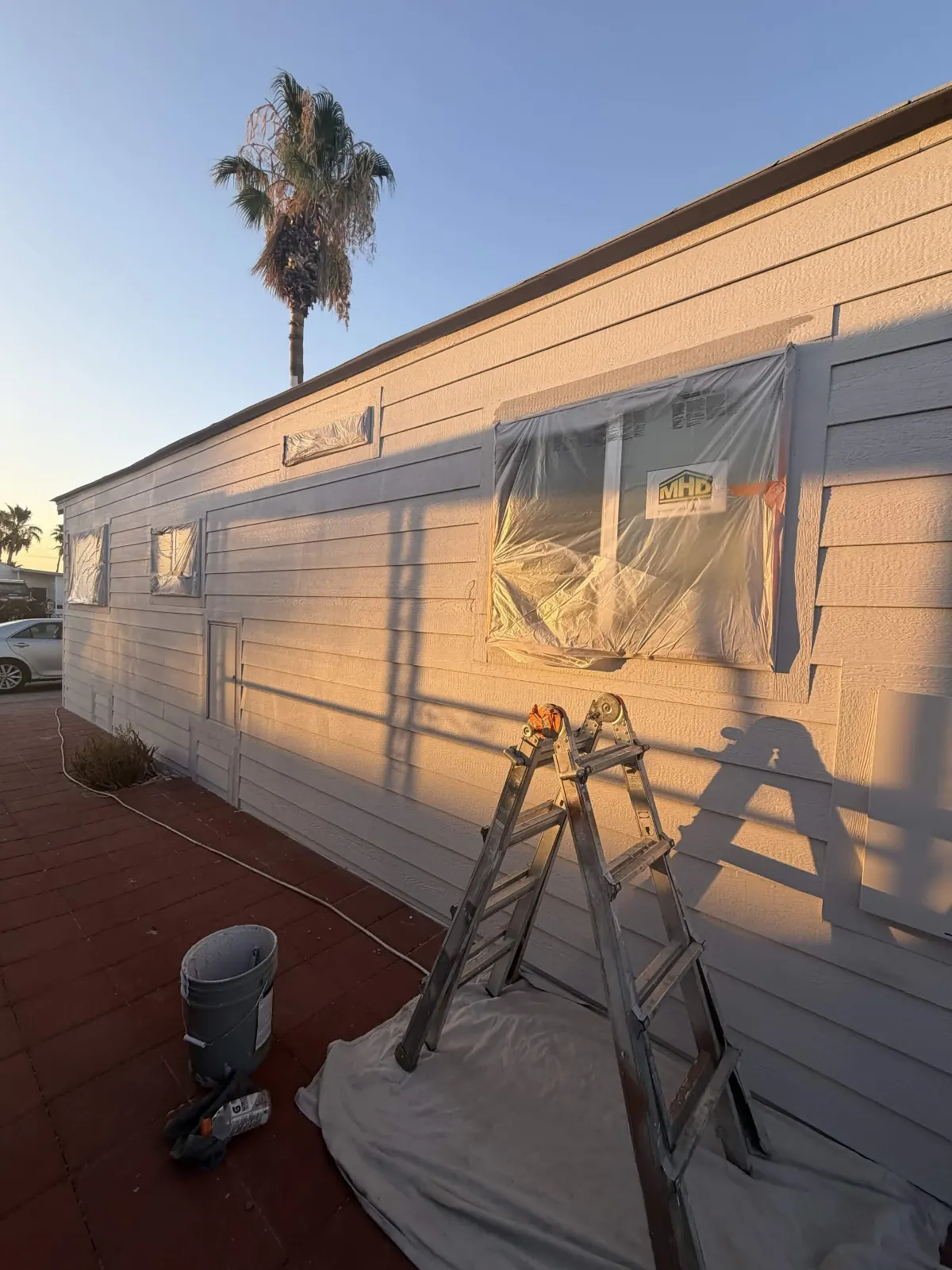
In full summer sun the khaki fades from view and the wall looks like pale sand. Under the low winter sun and in the hour before sunset, the warmth comes back and the house can look golden, particularly on west-facing walls.
In shaded entries and deep patios Canvas Tan settles into a soft greige. If your lot has decomposed granite, flagstone or tan pavers, it tends to sit right in with them, which is exactly what many West Valley homeowners want from a body color.
Canvas Tan inside the house
In a north-facing room the cool light leans it toward a gentle greige, so it rarely looks yellow there. In rooms with afternoon sun it warms up, and against white cabinets it reads as a definite but quiet tan.
It suits family rooms, open great rooms and hallways where you want warmth without much contrast. It also works with darker wood tones and bronze hardware, which can look heavy against stark white walls.
Best roles for Canvas Tan
- Main stucco body on a ranch or Spanish-style home with tan or brown tile
- Lighter field color in a two-tone scheme, with a deeper tan or brown on pop-outs
- Block walls and garden walls, so they blend with the house and the landscape
- Interior walls in open floor plans that connect kitchen, dining and living spaces
Pairings: trim, doors and the coordinating accent
- Redend Point (SW 9081), a Sherwin-Williams coordinating color, is a muted clay-brown that works on a front door, shutters or a recessed entry
- Creamy (SW 7012) or Alabaster (SW 7008) for fascia and window trim that is lighter than the body
- Universal Khaki (SW 6150) as a deeper partner on pop-outs and columns
- Urbane Bronze (SW 7048) for metal railings, gates and light fixtures
Heat, fading and an LRV of about 65
A light reflectance value of about 65 means the color sends back most of the visible light that lands on it. We calculate that number from the RGB values; Sherwin-Williams lists its own measured figure on the color page. In practical terms, a Canvas Tan wall stays cooler than the same wall in a mid-tone and much cooler than a dark brown.
Light tans also hide the slow fading and chalking that every exterior goes through in Arizona sun. A deep accent color like Redend Point will show that change sooner, so expect the door or shutters to need attention before the body does.
Sheen choices and our paint system
We finish stucco in Sherwin-Williams Emerald Exterior, priming any bare or patched areas with Loxon masonry primer and applying two coats, sprayed and back-rolled. A flat or low-sheen finish on the body keeps stucco texture looking even; a satin or semi-gloss on doors and trim makes them easier to wash.
For interiors we use low-VOC Emerald Interior, usually in eggshell or satin on walls and flat on ceilings.
Sampling Canvas Tan the right way
- Brush two coats onto a large board so the sample is solid and not streaky.
- Set it against the stucco on the sunniest and the shadiest side of the house.
- Look again after dark under your porch and garage lights, which can push it yellow or green.
- Check your HOA's approved color list and get written approval before the job is scheduled.
Frequently asked questions
- Is Canvas Tan yellow?
- It has a slight yellow-khaki lean, but it is muted enough that most people see a sandy tan rather than yellow. Cool north light makes it look more like a greige.
- What is Canvas Tan's coordinating accent color?
- Sherwin-Williams lists Redend Point (SW 9081) among its coordinating colors. It is a soft clay-brown that suits a front door or shutters against a Canvas Tan body.
- Does Canvas Tan work with a red tile roof?
- It can, but test it first. With tan or brown tile it blends easily; with strong red tile, look at a large sample next to the roof to make sure the khaki side does not clash.
- Is Canvas Tan too light for an exterior?
- No. At an LRV of about 65 it is light, but it still reads as a tan from the street. It will look paler in midday sun than it does on the chip, so most people are happy with it outside.
- Can Canvas Tan be used on block walls?
- Yes, and it is a good way to tie a perimeter wall to a tan house. Block needs proper cleaning and priming, and porous block often takes more paint than stucco.
- What sheen should Canvas Tan be on interior walls?
- Eggshell is a good default for living areas and bedrooms, and satin is better in kitchens, baths and kids' rooms. Keep flat for ceilings.