Paint color · Sherwin-Williams neutral
Sealskin (SW 7675): A Brown-Black for Doors, Islands and Accents
Published
Sealskin (SW 7675) is a near-black with a brown base, softer and warmer than a true black. Its RGB values are 72, 66 and 60, and we calculate its LRV at about 6 (5.6 before rounding), so it reflects very little light and works best on front doors, garage doors, shutters, kitchen islands and other accents.
Sherwin-Williams lists it among its neutrals. Its closest relative among our color pages is Iron Ore (SW 7069), which has the same calculated depth but a neutral, charcoal character.
Color swatch: Sealskin SW 7675, #48423C
| Code | SW 7675 |
|---|---|
| Hex | #48423C |
| RGB | 72, 66, 60 |
| LRV | About 6 (5.6, calculated from RGB) |
| Color family | Neutral (Sherwin-Williams); a warm brown-black |
Brown-black, by the numbers
Sealskin steps down evenly: red 72, green 66, blue 60. Six points between channels is a small spread in absolute terms, but at this depth it is enough to tip the color into brown. Up close it looks like espresso; across a yard it looks like a soft black with some warmth.
Tricorn Black (SW 6258), at 47, 47, 48, is far deeper and neutral, near 3 by our calculation. Sealskin is noticeably lighter than that, which is why it reads soft rather than stark.
Same depth as Iron Ore, different temperature
Iron Ore (SW 7069) is 67, 67, 65, and it also calculates to about 5.6. The difference is balance. Iron Ore's channels are nearly equal, so it reads as charcoal; Sealskin's red lead makes it brown. On a white or light gray house, Iron Ore usually fits better. On a beige, tan or cream house, or one with brown roof tile and warm stone, Sealskin keeps the dark accents in the same warm family.
Hardware tips the choice too. Brushed nickel and chrome look at home against Iron Ore's cooler cast, while brass, copper and oil-rubbed bronze pick up the brown in Sealskin and look warmer for it.
Outside: where a near-black belongs
- Front doors and sidelight frames, especially with brass or bronze hardware.
- Garage doors on warm-toned houses, as a softer choice than black.
- Shutters, window trim and a thin fascia line for a crisp outline.
- Metal railings, gates and light posts.
- Rarely the full body: big walls this dark carry a heavy heat load.
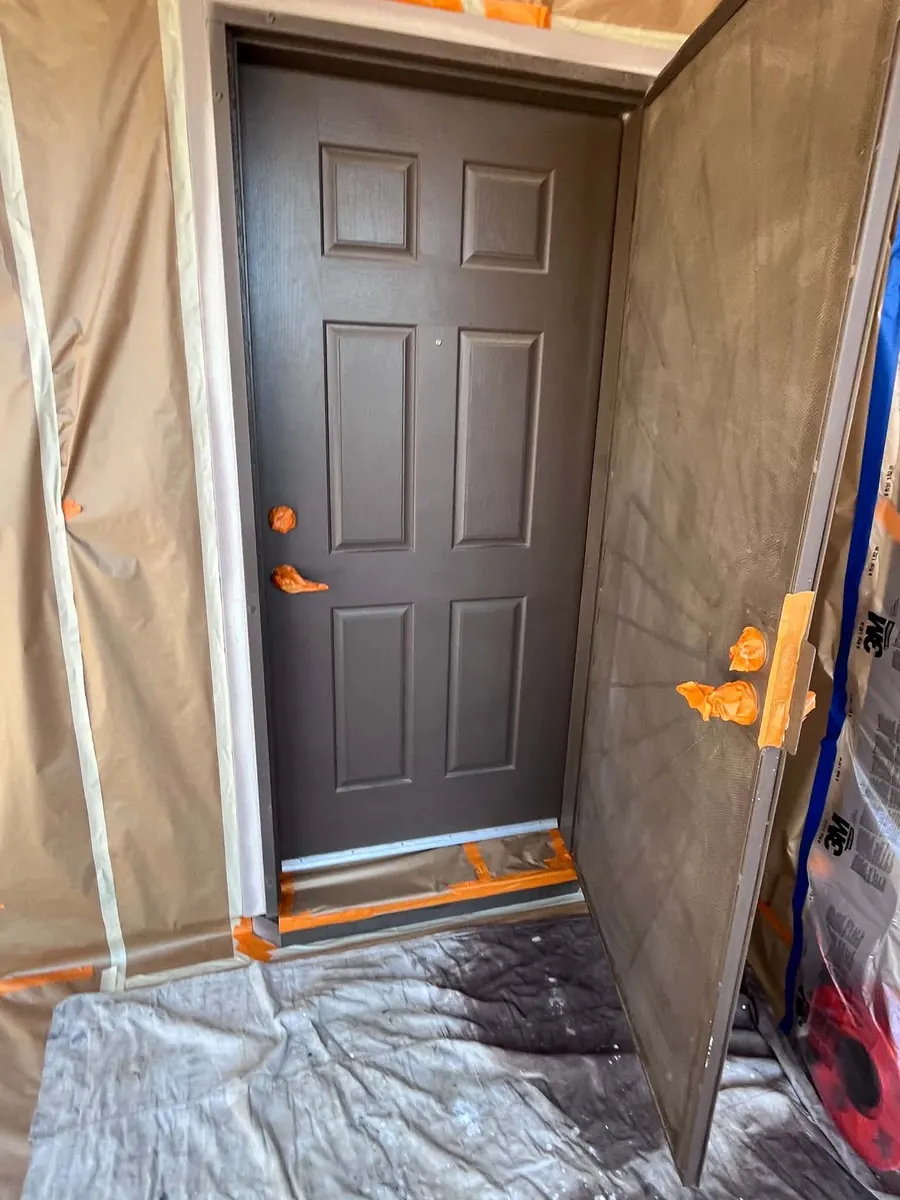
What an LRV near 6 does in the sun
A surface that reflects about 6 percent of visible light absorbs nearly all the sun's energy. A south- or west-facing door in Sealskin gets very hot in summer, and some door and window makers restrict dark colors on vinyl or fiberglass for that reason. Read the product's guidance before painting. Steel and wood generally tolerate dark colors when they are prepped and primed well.
Very dark colors also show sun wear first. Chalking appears as a pale haze, and fading is obvious next to a shaded part of the same door. Expect to refresh sunny doors before the body of the house needs it. Light-colored dust and pollen, on the other hand, show less on a brown-black than on a pure black.
Kitchen islands, vanities and built-ins
Inside, Sealskin is a warm alternative to black cabinetry. On an island with white or cream quartz, brass pulls and wood stools, it looks rich without the coldness of charcoal. It also works on bathroom vanities, built-in bookcases, interior doors and a fireplace wall.
Because it is so dark, lighting matters. In a north-facing room it can look flat; under warm bulbs the brown comes forward.
Origami White and the listed partners
Sherwin-Williams lists Origami White (SW 7636), SW 9168 and SW 6228 as coordinating colors. Origami White is 229, 226, 218, a soft off-white near 76: light enough for strong contrast with Sealskin, warm enough not to look stark. It works as the body on a modern stucco house or as the wall color around Sealskin cabinets.
- Warm body colors under Sealskin accents: Accessible Beige (SW 7036) or Kilim Beige (SW 6106).
- Crisp white trim: Pure White (SW 7005).
Why near-blacks need careful application
Near-blacks show everything: lap marks, roller texture, uneven sheen and thin spots over primer. We apply them in even coats with a wet edge, and on doors we lay the final strokes off in one direction. Two full coats of Sherwin-Williams Emerald Exterior give a uniform color outdoors, and on stucco, Loxon masonry primer goes onto bare or patched areas first. Satin is a forgiving sheen for doors and shutters.
Inside, cabinets and doors get low-VOC Emerald Interior in satin or semi-gloss after proper sanding and priming.
Testing Sealskin
- Paint a board and compare it with Iron Ore and with black, the usual alternatives.
- Hold it next to your hardware, roof tile and stone.
- View it in direct afternoon sun, where the brown shows most.
- For cabinets, check a sample door under your kitchen lights at night.
- Ask your HOA whether a near-black is approved for doors and trim.
Frequently asked questions
- Is Sealskin black or brown?
- It is a brown-black. In shade it looks almost black, and in sun the brown base shows.
- How does Sealskin compare with Iron Ore?
- Same calculated LRV, about 5.6, but Iron Ore (SW 7069) is a neutral charcoal while Sealskin is warmer and browner.
- Is Sealskin a good front door color in Arizona?
- It is a strong choice on warm-toned houses. A dark door in full sun gets hot, so check the maker's guidance for fiberglass or vinyl.
- What white goes with Sealskin?
- Origami White (SW 7636), one of its listed coordinating colors, gives soft contrast. Pure White (SW 7005) is crisper.
- Can I use Sealskin on kitchen cabinets?
- Yes, especially on an island or lower cabinets with light counters. Use satin or semi-gloss for durability.
- Is Sealskin too dark for a whole house?
- In Arizona sun, a body this dark gets very hot and shows fading sooner. Most homes use it for accents.
- Does Sealskin show dust and fingerprints?
- Less dust than a true black, because its brown base hides pale dust better. Fingerprints on satin or semi-gloss cabinets still show, so wipe them with a damp cloth rather than scrubbing.