Guide · Pool decks
Can You Coat Over Pavers Around a Pool?
By the Orange Coatings team · Published
Usually not with the kind of solid, textured coating used on concrete pool decks. Most pool pavers are laid on sand and gravel with sand-filled joints, so each paver moves a little on its own, and a continuous film over them cracks along every joint and traps water underneath.
Pavers do better with cleaning, re-leveling, fresh joint sand and a sealer made for pavers. If what you really want is the one-color, textured look of a coated deck, that generally means a concrete deck, either the one you already have or a new slab. Here is how to tell what you have and which path fits.
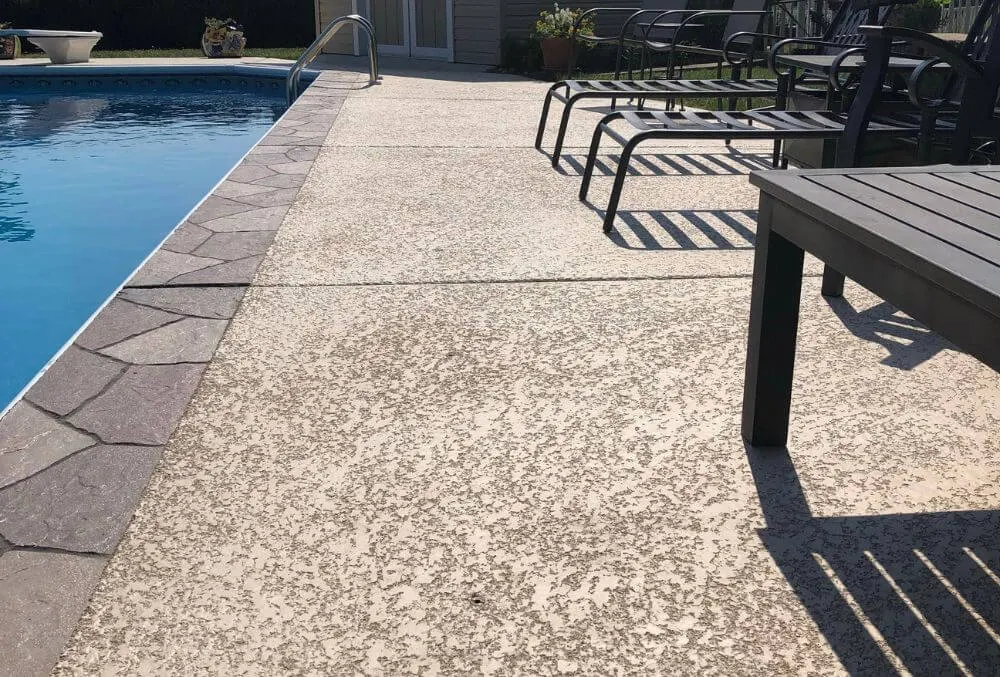
First, find out how your pavers were installed
The answer depends on what is under the pavers, and you can often tell from the joints.
- Sand-set pavers: joints filled with loose or polymeric sand, pavers can shift slightly, edges may have settled. This is how most backyard paver decks are built.
- Mortar-set pavers or stone: joints filled with hard grout or mortar, pavers bonded to a concrete slab underneath. These behave more like a tiled slab.
- Concrete with a paver pattern: a single slab stamped or scored to look like pavers, with no real joints. This is concrete and can be coated like any concrete deck.
Why a solid coating fails on sand-set pavers
A pool deck coating is designed to bond to one continuous surface. Sand-set pavers are hundreds of separate pieces, each able to rock, settle and expand on its own as the deck heats and cools. A film stretched across them has to crack somewhere, and it cracks at the joints, usually within the first summer.
The cracks are only the start. Water from splash-out and monsoon rain gets under the film at every crack, the sand below washes out, and the coating starts lifting at the edges. Moisture trapped under the film can also bring up white mineral deposits from the pavers, which show as a cloudy haze under the coating.
What pavers need instead
- Clean the pavers thoroughly to remove algae, sunscreen, leaf stains and hard-water spots.
- Pull and reset any pavers that have sunk, lifted or rocked loose, especially along the coping and edges.
- Refill the joints with fresh sand, or polymeric sand installed to its maker's directions.
- Let everything dry, and clean off any white efflorescence before sealing.
- Apply a sealer made for pavers, choosing the finish with traction in mind.
Sealing pavers around water
Unilock, a paver manufacturer, says a sealer can enhance color, help keep sand joints intact and protect against stains and fading, and it recommends sealing for pool decks. It also warns that glossy finishes can get slippery when wet and suggests a penetrating matte sealer to keep texture and traction. Around a pool, where bare feet and splash meet every day, a wet-look gloss is the wrong trade.
Unilock also notes many owners reapply every three to five years, and that sealing is not a cure for poor drainage or base problems. Sealing protects pavers that are already sound; it does not fix ones that are moving.
Mortar-set pavers on a slab
Pavers or stone bonded to a concrete slab with mortar joints are a different case, but they are still not a natural fit for a full coating. Grout lines and the paver faces absorb and move differently, glazed or very dense pavers give a coating little to grip, and any cracked grout joint will telegraph through. Some owners in this position choose to clean, repair the grout and seal instead. Whether a coating is even an option has to be judged in person, joint by joint.
When switching to a coated concrete deck makes sense
Some homeowners want out of pavers entirely: no weeds in the joints, no sunken edges, one even color that stays cooler underfoot. The way to get that is removing the pavers and having a concrete deck poured, which is concrete work rather than a coating job. Once the new slab has cured as long as its coating's data sheet requires, it can be finished with a slip-resistant deck coating like any other concrete deck.
It is a bigger project, so it usually makes sense only when the pavers have widespread settling, the base has failed, or the deck is being reworked anyway, such as during a pool remodel.
What we coat, and how we can help
Our pool deck work is on concrete decks and cementitious cool-deck surfaces such as Kool Deck. The process is pressure washing and degreasing, crack repair and patching, removing loose coating, profiling the surface, masking coping, tile, drains and equipment, then a slip-resistant Sherwin-Williams pool deck system in a light color that stays cooler underfoot.
If you are not sure whether your deck is pavers or patterned concrete, we will look at it with you at the same-day estimate and tell you straight whether a coating is the right fit.
Frequently asked questions
- Can I paint my pool pavers a new color?
- Paint or a solid deck coating on sand-set pavers tends to crack at the joints and peel where water gets under it. Cleaning and sealing, or a color-enhancing paver sealer, is the more lasting way to refresh them.
- Will sealing make my pool pavers slippery?
- A glossy, wet-look film can. A penetrating or matte sealer leaves the surface texture alone, which is why it is the usual recommendation around pools.
- My deck looks like pavers but has no sand joints. Can it be coated?
- If it is one concrete slab stamped or scored in a paver pattern, yes. It is prepared and coated like other concrete decks, and the pattern lines can still show through the texture.
- Why are my pool pavers turning white?
- A white haze is often efflorescence, mineral salts carried to the surface by moisture moving through the pavers. It should be cleaned off and the pavers allowed to dry before any sealer goes on.
- Should pool paver joints be filled with polymeric sand?
- Polymeric sand stiffens once activated, so it resists washout from splash and hosing better than loose sand. It only works when it is swept clean off the paver faces and activated to its maker's directions, and Unilock notes this has to happen correctly before any sealer goes on.
- Is concrete or pavers better around a pool in Arizona?
- Both work. Pavers can be lifted and reset in sections, while a coated concrete deck gives one continuous, textured surface in a light color that stays cooler and has no joints for weeds.
Related
- Pool deck coatings
- Kool Deck resurfacing
- Patio and walkway coatings
- Pool deck coatings in Surprise, AZ
- Pool deck coatings in Buckeye, AZ
- Pool deck coatings in Sun City, AZ
- Pool deck coating colors that stay cooler
- Kool Deck repair: recoat or replace?
- Can You Put Epoxy Over a Cracked Garage Floor?
- Can You Paint an Alumawood or Aluminum Patio Cover?
- How Soon Can You Use the Pool After a Pool Deck Coating?