Guide · Epoxy flooring
Can You Put Epoxy Over a Cracked Garage Floor?
By the Orange Coatings team · Published
Yes, most cracked garage floors can be epoxied, as long as the cracks are repaired the right way first. Cracks that have stopped moving get filled and ground flush so the coating goes straight over them; cracks and joints that still move need a flexible treatment so the coating does not try to bridge them.
What you cannot do is roll epoxy over an open crack and expect it to disappear. The coating will sink into it, crack along it, or both. The rest of this guide covers how to read the cracks in your slab and what each kind needs.
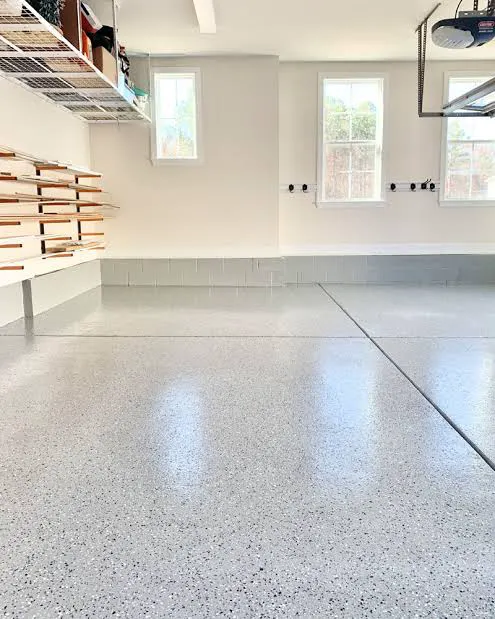
Almost every garage slab has cracks
Concrete shrinks as it cures, and a slab that size has to relieve that stress somewhere. That is why garages have control joints: the straight grooves sawn or tooled across the floor. Carboline, a coatings maker, describes them as cuts that weaken the slab on purpose so shrinkage cracks form along the groove instead of at random.
So a few hairline cracks, especially near corners and the garage door, do not mean the slab is failing. The question for a coating is whether each crack is still moving.
Static and moving cracks
Carboline separates cracks into two kinds. Static cracks, typically from shrinkage, are fixed and no longer moving. Dynamic cracks come from structural movement and open and close with temperature, humidity and load. The repair is different for each, and getting it wrong is what makes a crack reappear in a new floor.
- Hairline cracks with no height difference between the sides: usually static
- Random cracks that have not grown in years: usually static
- Control joints in a slab that is several years old: often treated as static, filled and coated over
- Cracks where one side sits higher than the other: movement, now or in the past
- Cracks that reopen after being patched, or widen in summer: moving
- Expansion joints, where the slab meets the house foundation or the driveway: built to move
How to check a crack yourself
- Run a coin or credit card across the crack. If it catches on a raised edge, note it.
- Draw two short pencil lines across the crack and write the date beside them.
- Measure the gap at the lines with a ruler or feeler gauge.
- Check again after a few weeks, ideally across a change of season.
- If the lines have shifted or the gap has changed, treat it as a moving crack.
Repairing static cracks before coating
For static cracks and control joints, Carboline's approach is to fill the full depth with an epoxy repair material, grind it smooth, and apply the coating system over it. In practice the crack is first opened slightly with a grinder so the filler has clean, sound edges to grab, then vacuumed out. After the filler cures, it is ground level with the slab so it does not show as a ridge under the coating.
Divots, spalls and pitted areas near the door get the same treatment. Anything left hollow will show through the finished floor as a dip, and coating will not fill it neatly.
Treating cracks and joints that move
A rigid filler in a moving crack will just crack again, and the coating over it will crack with it. For dynamic cracks and expansion joints, Carboline calls for a backer rod sized to the joint and a flexible sealant, recessed rather than filled flush, so the joint can still move. The coating stops at the edges of that joint instead of running across it.
That means the joint stays visible as a line in the floor. It is the honest trade-off: a joint that shows is far better than a coating that tears along it every summer.
Will the crack show through later?
Sometimes, faintly. Even a well-filled crack can show a hairline in the finished floor if the slab shifts a little over the years. A decorative flake broadcast makes this much less noticeable, because the eye reads a busy chip pattern rather than a smooth, solid color. If your slab has a lot of repaired cracks, flakes are usually the practical choice over a solid or metallic finish.
A hairline in the coating that follows an old crack is cosmetic as long as the coating on both sides is still bonded. Peeling or chipping along it is a different matter and worth having looked at.
When a crack needs more than a coating contractor
Some cracks point to settlement, drainage or slab problems underneath. Coating over them hides the symptom for a while and then fails. If you see any of the following, have the slab assessed, and repaired if needed, before any floor system goes down.
- Sections that have sunk or lifted noticeably, creating a trip edge
- Cracks wide enough to fit a pencil that are still growing
- Crumbling or broken pieces that move underfoot
- Water coming up through a crack, or a damp line along it
How we handle a cracked slab
Crack and divot repair is part of every epoxy floor we install, along with cleaning, degreasing and profiling the concrete so the coating bonds. We walk the slab with you at the estimate, point out which cracks we will fill and which joints should stay flexible, and recommend a finish that suits how much repair the floor needs. The coating itself is a Sherwin-Williams epoxy floor system, with optional flakes, a clear topcoat and an anti-slip additive.
Frequently asked questions
- Should hairline cracks be filled before epoxy?
- Yes. Even fine cracks are opened slightly, filled and ground flush, so the coating sits on a smooth, solid surface. Left open, they tend to show through as thin dark lines.
- Do control joints get filled or left open?
- It depends on the slab. On an older garage where the joints have stopped moving, they are often filled and coated over for a smooth floor; where movement is expected, they are kept flexible and the coating stops at the joint.
- Will epoxy stop my garage floor from cracking more?
- No. A coating sits on the slab and cannot hold concrete together. It protects and finishes the surface, while movement has to be dealt with at its cause.
- Can epoxy fix a crack with an uneven edge?
- A small lip can be ground down and filled. A large height difference means the slab has moved, and that needs to be assessed before coating.
- Do flakes hide repaired cracks?
- They hide them well. The chip pattern breaks up the surface so a filled crack, or a faint line that appears later, is hard to spot.
Related
- Epoxy flooring
- Flake epoxy garage floors
- Warehouse floor coatings
- Epoxy flooring in Glendale, AZ
- Epoxy flooring in Goodyear, AZ
- Epoxy flooring in Sun City, AZ
- Driveway coatings
- Why garage epoxy peels in Arizona
- Can You Coat Over Pavers Around a Pool?
- Can You Paint an Alumawood or Aluminum Patio Cover?
- Garage Floor Paint vs. a Real Epoxy Coating
- How Soon Can You Use the Pool After a Pool Deck Coating?