Guide · Pool deck coatings
Pool Deck Coating Colors That Stay Cooler
By the Orange Coatings team · Published
The coolest pool deck colors are light, low-saturation shades: warm off-whites, pale tans, sand and light grays. They reflect more of the sun's energy than charcoal, brown or terracotta, so the surface heats up less by mid-afternoon.
Color is not a miracle fix, though. A light deck in a Phoenix July is still warm, just far more bearable than a dark one. Below we cover why color matters, which shades work, what to avoid, and the other things that keep a deck comfortable.
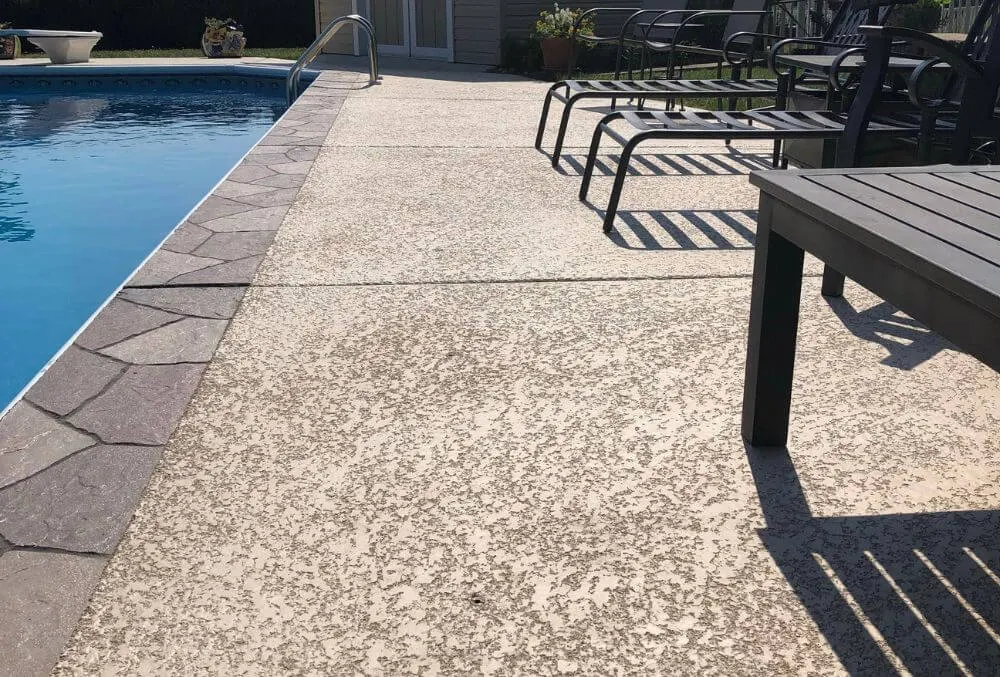
Why deck color changes how hot it feels
Sunlight that a surface does not reflect is absorbed and turned into heat. Dark pigments absorb most of it, light pigments bounce much of it back. Concrete also stores that heat, which is why a deck can still feel hot an hour after the sun drops behind the house.
The numbers in the desert are not small. Concrete commonly runs 30 to 50°F hotter than the air on a sunny day, according to a decorative concrete pigment maker. An EPA summary of an Arizona pilot study reports conventional paving reaching about 152°F at midday, with reflective "cool" pavements staying 10 to 16°F cooler at the surface.
Reflectance numbers: SRI and LRV in plain terms
Two numbers come up when people compare surfaces. Solar Reflectance Index (SRI) rates how well a material rejects solar heat; higher is cooler. Plain gray concrete sits around SRI 35, while titanium-dioxide whites can reach 80 to 90. A light shell-colored concrete pigment rated about SRI 56 is reported to keep a slab roughly 10 to 25°F cooler than standard gray at peak sun.
Paint colors usually list Light Reflectance Value (LRV) instead, on a scale from 0 (black) to 100 (white). LRV measures visible light only, and a big share of the sun's heat arrives as infrared, so treat it as a rough guide. Still, a deck color with an LRV in the 55 to 75 range will almost always run cooler than one under 20.
Colors that stay cooler underfoot
These are the families we steer homeowners toward. The Sherwin-Williams colors named here are wall colors with calculated LRVs listed on our color pages; use them as a reference for the shade you want and ask what the deck system can be tinted to.
- Warm off-white, in the range of Navajo White (calculated LRV about 73): very cool, but bright in full sun
- Pale tan or sand, in the range of Canvas Tan (about 65): cool, and it hides desert dust well
- Light greige, in the range of Agreeable Gray (about 60): pairs with most stucco body colors
- Soft beige, in the range of Accessible Beige (about 58): warm, forgiving with hard-water spots
- Light cool gray: a good match for modern homes with white or charcoal trim
Colors that run hot
Charcoal, deep brown, slate, brick red and saturated terracotta look sharp in a rendering and painful at 3 p.m. in August. Colors like Iron Ore or Urbane Bronze, with calculated LRVs under 10, absorb nearly all visible light. Save darker tones for a narrow border or a band along the coping if you want contrast, and keep the walking field light.
Why not just go pure white?
Bright white is the most reflective choice, but it has real downsides beside a pool in Arizona. The glare off a white deck at noon is hard on the eyes, and it shows rust from patio furniture, leaf tannin, sunscreen and tracked-in dirt within days. A warm off-white or pale sand gives up a little reflectance in exchange for a deck you can look at and keep clean.
Light tans and grays also hide the dust that blows in from the desert and the white mineral spots left by splash-out, which matters when you hose the deck down weekly.
Texture matters almost as much as color
A slip-resistant texture keeps traction when the deck is wet, and a knocked-down or broomed surface also feels a bit cooler than a smooth one because less of your foot touches the hot surface at once. Our pool deck coatings use slip-resistant Sherwin-Williams systems, and at the estimate we show texture options so you can pick the feel you want under bare feet.
Some deck coatings go further with heat-reflective pigments. Sherwin-Williams markets its H&C Acryla-Deck hi-build coating as reducing concrete surface temperature by up to 20°F. Manufacturer figures like that come from their own test conditions, so read them as a comparison, not a promise for your yard.
Other ways to keep a deck comfortable
- Shade: a pergola, shade sail or tree canopy over the main seating area can drop that section's surface temperature by 15 to 20°F
- Rinse before use: a quick hose-down cools the surface for a short swim session
- Misting lines along a patio cover take a few degrees off nearby concrete
- Outdoor mats or a rug in the path from the back door to the steps
- Keep the coating in good shape: chalky, worn coatings expose darker bare concrete underneath
Matching the deck to the house
The deck should relate to the stucco and the trim, not fight them. A common approach is a deck a shade or two lighter than the body color, in the same warm or cool family. If your home is a warm beige, a sand or pale tan deck reads as part of the house; if it is a cool gray, a light gray deck does the same. We bring samples to the same-day estimate so you can see them on your concrete in real sun instead of on a screen.
If the deck sits next to newly painted walls, coordinate both at once. It is easier to pick one palette for the house, block walls and deck than to match a new deck to paint that will be redone in a year.
Frequently asked questions
- What is the coolest color for a pool deck in Arizona?
- A warm off-white or pale sand is close to the coolest practical choice. Pure white reflects slightly more, but the glare and constant visible dirt make it hard to live with beside a pool.
- Does a gray pool deck get hotter than a tan one?
- It depends on how light each one is, not the hue itself. A light gray and a light tan with similar reflectance will feel about the same, while a mid or dark gray will run noticeably hotter than either.
- Will a light deck coating stain more easily?
- Light colors show rust, leaves and dark dirt sooner than mid-tones. A light tan or greige hides dust and mineral spots well, and a quick rinse each week keeps most marks from setting.
- Can I use a dark border and a light field?
- Yes, and it is a good way to get contrast without a hot walking surface. Keep the dark band narrow and away from the paths people use between the house and the pool steps.
- Does coating color affect how long the deck lasts?
- Darker colors run hotter, and more heat means more expansion and contraction of the slab and the coating. Light colors also hide early fading, so the deck looks fresh longer between recoats.
- Can the deck color match my exterior paint?
- Usually it can coordinate closely, though deck systems have their own tint options. We help you pick a shade that sits a step lighter than your stucco so the whole yard reads as one scheme.