Guide · Stucco
How Many Coats of Paint Does Stucco Need?
By the Orange Coatings team · Published
Stucco needs two full coats of exterior paint, and any bare, new or patched stucco needs a masonry primer underneath them. One coat almost never builds enough paint film to cover the peaks and valleys of the texture, and in the Arizona sun a thin film fades, chalks and cracks years sooner.
Below we explain why the second coat matters so much on stucco, when a wall needs more than two, and how to tell from the estimate whether a painter is really planning to put two on.
The short answer by situation
- Repaint, same or similar color, sound old paint: wash, repair, spot-prime patches, then two finish coats.
- Bare or brand-new stucco: a full coat of masonry primer, then two finish coats.
- Big color change, especially dark to light: two coats is the minimum, and a third may be needed for even color.
- Chalky, weathered paint: wash thoroughly and use a primer or conditioner suited to chalky surfaces before the two finish coats.
- Elastomeric coating: applied heavier than paint and usually in two coats, at the thickness the product label calls for.
Why one coat is not enough on stucco
Stucco is rough and porous. Look at a sand or lace finish up close and you will see ridges, pits and tiny holes. A single pass of paint lands thick on the high points and thin, or not at all, in the low ones. From the curb it may look covered, but up close you can often see pinholes and shadowed spots where the old color or bare cement shows through.
The bigger problem is film thickness. A paint's durability depends on how much dried coating actually sits on the wall. Ultraviolet light slowly breaks down the surface of every exterior paint, and a thin film runs out of material to lose much sooner. A second coat roughly doubles what the sun has to wear through, which is why two coats on a sun-facing wall in the West Valley lasts far longer than one heavy-looking coat.
Where primer fits in
Primer is not a finish coat and should not be counted as one. Its job is to seal the surface and give the paint something to grip. New stucco and fresh patch material are alkaline, and that alkalinity can attack a finish paint and cause poor adhesion or blotchy color.
Many premium exterior paints, including Sherwin-Williams Emerald Exterior, are sold as self-priming on many surfaces. That helps on sound, previously painted walls. On bare or patched stucco we still use Sherwin-Williams Loxon masonry primer first, because those areas are where early peeling starts.
Spray, back-roll, repeat
How the coats go on matters as much as how many. An airless sprayer puts paint on stucco quickly, but spray tends to bridge over the valleys in the texture. Back-rolling right behind the sprayer, while the paint is still wet, works it down into the pits and pinholes so the whole surface is covered.
Our stucco standard is two coats of Emerald Exterior, each one sprayed and back-rolled. The second coat goes on after the first has dried for the time on the label, not on the same wet film.
How to check that you are getting two coats
- Read the written estimate. It should name the primer, the finish product and the number of finish coats.
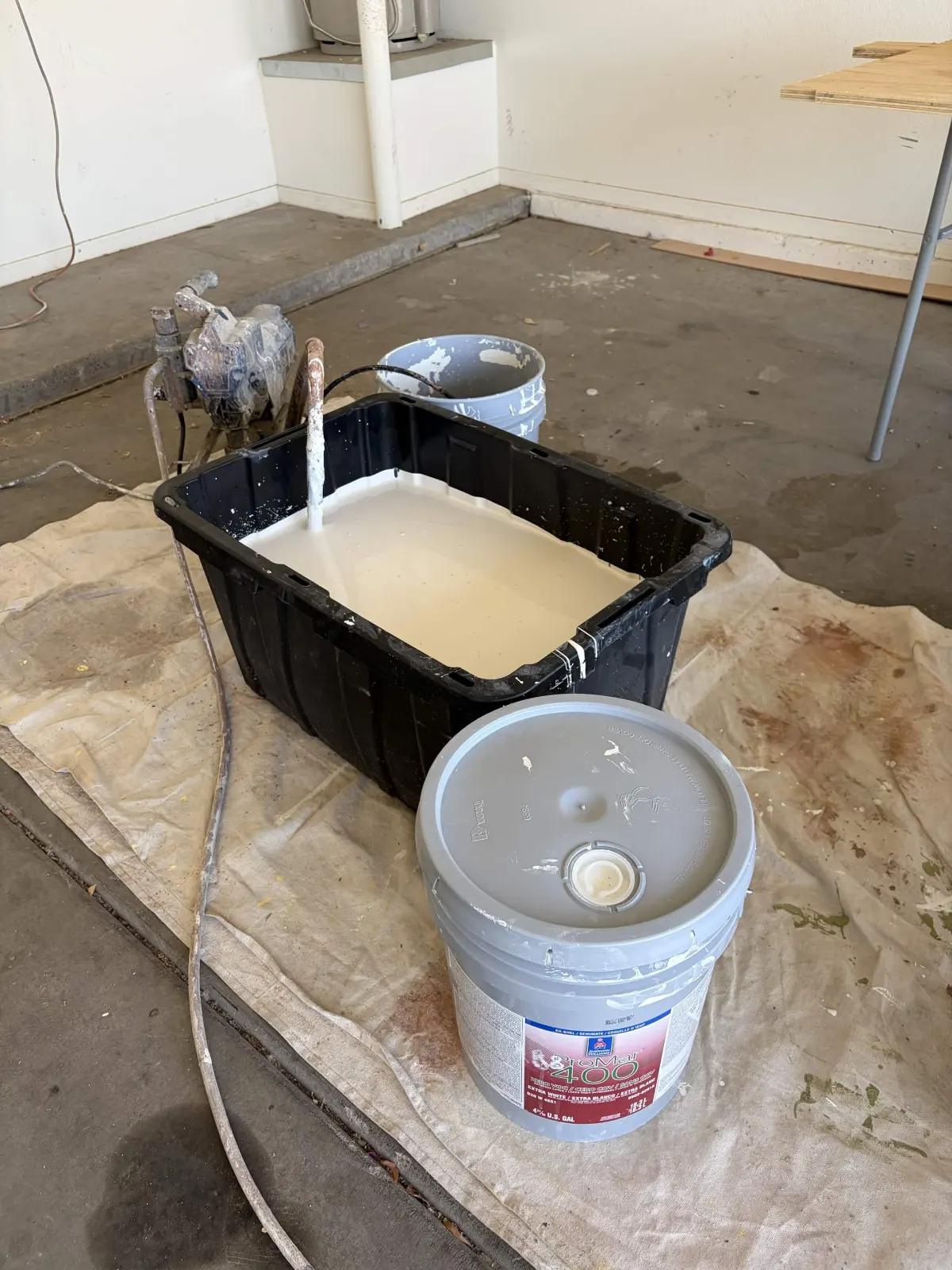
- Ask how much paint the job is expected to use. Two coats on a full stucco house means a lot of five-gallon buckets, not a handful.
- Ask whether the coats will be back-rolled on the stucco, or sprayed only.
- Look at a wall between coats. After the first coat, a slight difference in sheen or shade is normal; the second coat evens it out.
- At the final walkthrough, check the texture up close in raking light for pinholes and thin spots, especially near the ground and under eaves.
Coverage rates and why stucco uses more paint
Paint labels give a spread rate, the square feet one gallon covers at the recommended thickness. That number assumes a fairly smooth surface. Textured stucco has far more actual surface area than its flat measurement, and it soaks up paint, so expect a gallon to cover noticeably less than the label suggests.
This is one of the ways cheap bids hide a shortcut. If a quote seems to use about half the paint you would expect for the wall area, it may be planning one coat, or two thin coats stretched to the coverage of one.
When a third coat makes sense
Some colors hide less than others. Deep reds, bright yellows and some saturated accent colors use tint bases that cover poorly, and they can need a third coat or a gray-tinted primer to reach full, even color. Going from a dark body color to a light one is the other common case.
A third coat is not a fix for skipped prep. If walls were not washed, or cracks were not repaired, extra paint just builds a thicker film over a weak base.
Timing coats in Arizona weather
Heat shortens dry times, which sounds helpful but can cause trouble. Paint applied to a wall in full afternoon sun can skin over before it levels or bonds, leaving lap marks and a weaker film. In summer we work around the sun, following the shade around the house. During monsoon season we watch for storms, because rain on a coat that has not dried can wash off or spot the finish. Each product's label lists its temperature range and recoat time, and both coats should go on inside those limits.
Frequently asked questions
- Can I get away with one coat if I am painting the same color?
- On stucco, one coat rarely builds enough film to last, even in the same color. You save one day of labor and lose years off the paint job, especially on south and west walls.
- Does primer count as one of the two coats?
- No. Primer seals and bonds the surface; the two finish coats carry the color and the weather protection. Count them separately when comparing estimates.
- Is paint-and-primer-in-one enough for bare stucco?
- We do not rely on it for bare or freshly patched stucco. Those areas get a dedicated masonry primer such as Loxon first, then the finish coats.
- How long should I wait between coats on stucco?
- Follow the recoat time printed on the product label, which depends on temperature and humidity. In warm, dry weather it can be a matter of hours, but cool or humid days stretch it.
- Do stucco garden walls and block walls need two coats too?
- Yes, for the same reasons. Masonry walls are porous and sit in full sun, and they also take sprinkler water, so two coats over a sound, primed surface is the right standard.