Paint color · Light warm tan
Ramie (SW 6156): Light Warm Tan for Stucco and Interiors
Published
Ramie (SW 6156) is a light, warm tan from Sherwin-Williams, sitting between beige and wheat. With an LRV of about 52, calculated from the RGB values, it gives a stucco house a soft desert color while still bouncing back roughly half the light that lands on it.
It makes an easy backdrop for darker accents like navy and gray-green, and Sherwin-Williams lists it as a coordinating color for Naval (SW 6244), a good hint at the kind of contrast it handles well.
Color swatch: Ramie SW 6156, #CDBDA2
| Color | Ramie |
|---|---|
| Code | SW 6156 |
| Hex | #CDBDA2 |
| RGB | 205, 189, 162 |
| LRV | About 52 (calculated from the RGB values) |
| Color family | Light warm tan, soft wheat beige |
What does Ramie look like on a wall?
Ramie's RGB values are 205, 189 and 162. Red leads, blue is lowest, and the gap between them is wide, so this is plainly a warm color. On most walls it reads as a light tan with a gentle yellow lean, and in some light a faint green note appears, the way natural linen fiber looks slightly green-beige.
Beside white trim it looks like warm sand. Beside a deeper tan like Stone Lion (SW 7507), it looks light and almost creamy. Beside a cool gray it can look surprisingly yellow, so pay attention to what else is fixed on the house.
Ramie in strong sun and in north light
Bright Arizona sun lifts Ramie toward cream on south and west walls at midday, and the color can look a full step lighter than the chip. Late in the day on a west elevation it turns golden. On the north side of the house or under a patio cover, it settles into a mid beige closer to what you saw in the store.
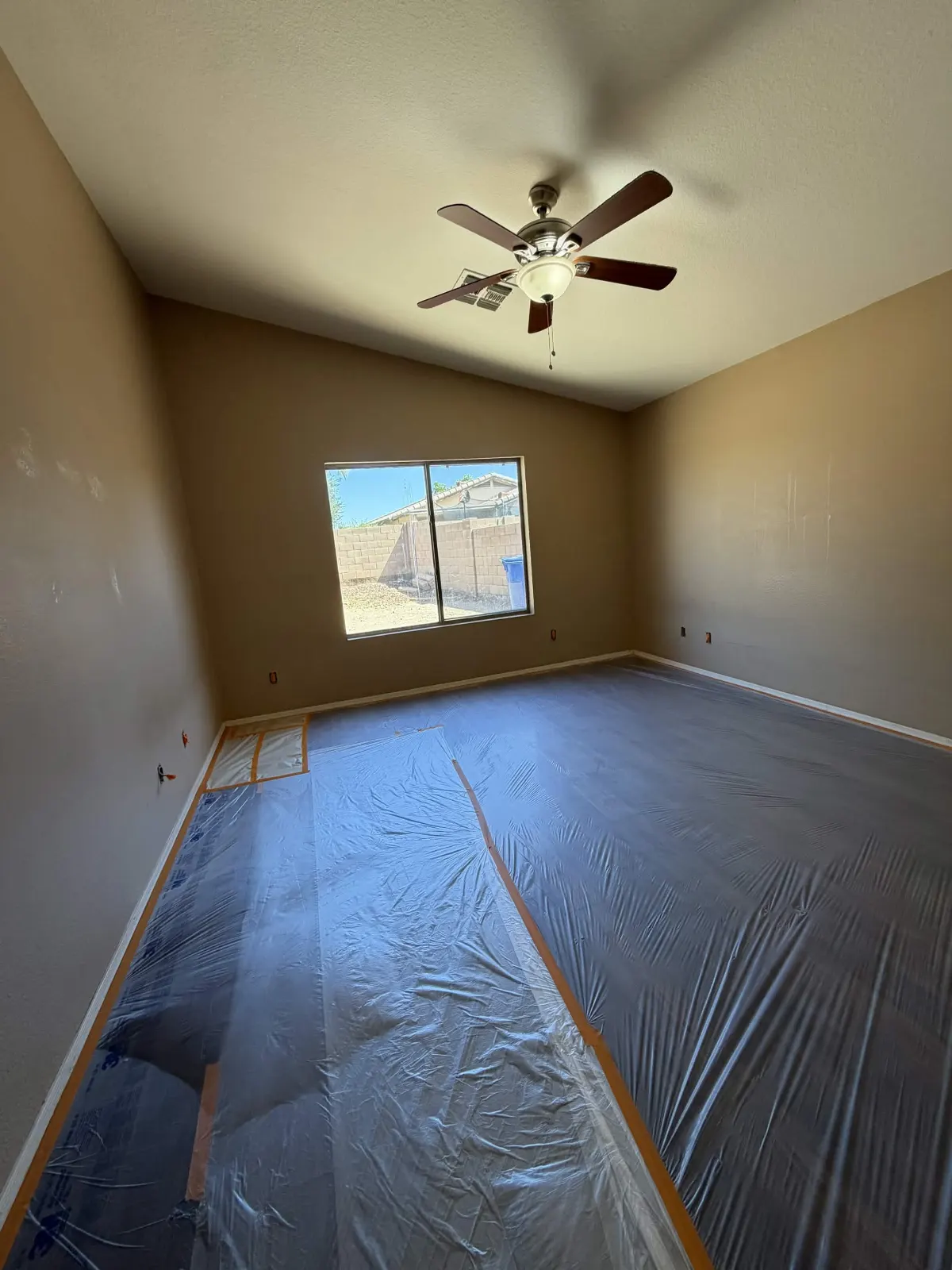
Indoors, a north-facing room drains some of Ramie's warmth and can make it look slightly green or putty-gray. South and west light make it sunny and comfortable. Warm 2700K bulbs at night push it yellow, while 3000K to 3500K bulbs keep it closer to a neutral tan.
Where Ramie fits
Ramie is less successful in a modern scheme with black windows, gray tile and cool concrete, where it can look dated. It also tends to look dingy in a room with very little daylight.
- Whole-house stucco body color with white or cream trim
- Upper body color over a deeper tan band on a two-tone house
- Interior walls in Southwestern, Spanish Colonial or traditional homes
- A background for dark doors and shutters in navy or gray-green
- Garden walls and gates on a light-colored house
What to pair with Ramie
Sherwin-Williams' coordinating colors for Ramie are SW 6154, SW 6155 and SW 6166. Beyond those codes, the colors below sit well beside it; these are our suggestions rather than Sherwin-Williams' coordinating list.
- Navy front door or shutters: Naval (SW 6244) or Indigo Batik (SW 7602)
- Gray-green door or trim: Pewter Green (SW 6208)
- Creamy trim: Antique White (SW 6119)
- Deeper tan for the lower band of a two-tone house: Stone Lion (SW 7507)
Heat and fading at an LRV of about 52
Ramie reflects about half of visible light, so a stucco wall in this color stays noticeably cooler than a mid-tone or dark body while still looking like a real color rather than an off-white. For many Arizona homeowners, that light-to-mid range is the comfortable compromise between heat and character.
Warm tans are usually built from iron-oxide type earth pigments, which hold up well under UV. Ramie tends to age by lightening a little on the sunniest walls, which is hard to see from the street. It hides dust better than white, though not as well as a mid-tone like Stone Lion.
Ramie with tile roofs and desert yards
Ramie pairs naturally with brown, terracotta and blended concrete tile, flagstone, and gold or tan decomposed granite. Next to a charcoal roof and gray pavers it can look flat; there, a warmer gray or greige may look more intentional.
Tan block walls are often close to Ramie in color. Painting the walls to match the house, or one shade darker, makes the lot feel connected instead of showing two slightly different tans side by side.
Sheen and product choices for a light tan
On stucco, we use Sherwin-Williams Emerald Exterior in two coats, sprayed and back-rolled so the paint gets pushed into the texture, with Loxon masonry primer on any bare or patched stucco. Patches that are not primed often show through a light tan as darker or shinier blotches, so that primer step matters on a color like this.
A flat body finish is the most forgiving on stucco. Doors and trim look cleaner in satin. Inside, Emerald Interior in eggshell is a good wall default, and it is a low-VOC product.
Testing Ramie
- Roll two coats on a large sample board rather than relying on a small chip.
- Compare it beside your roof tile, block walls and window frames.
- Check it in midday sun, late afternoon and full shade.
- For interior rooms, look at it at night under the bulbs you actually use.
- Confirm with your HOA before choosing it for the exterior.
Frequently asked questions
- Is Ramie beige or tan?
- It is a light, warm tan between beige and wheat. In bright sun it can look creamy; in shade, more like a mid beige.
- What door colors go with Ramie?
- Sherwin-Williams lists Ramie as a coordinating color for Naval (SW 6244), so a navy door is a natural match. Gray-greens like Pewter Green (SW 6208) also look good against it.
- Is Ramie a good exterior color for Arizona?
- Yes, at a calculated LRV of about 52 it stays cooler than mid-tones and dark colors, and warm tans generally hold their color well. Sample it next to your roof tile before deciding.
- Does Ramie look yellow?
- It can look slightly yellow under warm bulbs, in late-afternoon sun, or next to a cool gray. In north light it looks more neutral.
- What trim color goes with a Ramie body?
- A creamy white like Antique White (SW 6119) keeps the scheme soft and warm. A cleaner, brighter white gives more contrast but can look stark in full sun.
- Can Ramie be used inside?
- Yes, it suits living rooms and bedrooms with warm daylight and wood floors. In a dim north room it can look flat, so test it there.