Paint color · Sherwin-Williams neutral
Warm Stone (SW 7032): A Deep Taupe for Accents, Bands and Walls
Published
Warm Stone (SW 7032) is a deep taupe-brown, the color of damp sandstone or weathered flagstone. From its RGB values of 136, 123 and 108 we calculate an LRV of about 20, which makes it a dark mid-tone: rich and earthy outdoors, but hot enough in full sun that it suits accents better than an entire stucco body.
Sherwin-Williams lists it among its neutrals and pairs it with two light greiges, Incredible White (SW 7028) and Agreeable Gray (SW 7029). That pairing points to its best job: a grounding color under and around a light house.
Color swatch: Warm Stone SW 7032, #887B6C
| Code | SW 7032 |
|---|---|
| Hex | #887B6C |
| RGB | 136, 123, 108 |
| LRV | About 20 (calculated from RGB) |
| Color family | Neutral (Sherwin-Williams); a brown-leaning taupe |
Where the warmth comes from
Red leads at 136, green follows 13 points lower, and blue trails 15 points below that. A steady drop from red to blue is the signature of a warm brown-taupe. Compared with Anonymous (SW 7046), at 129, 122, 110, Warm Stone has a bigger gap between red and green, so it shows more brown and less gray, and it is also a little lighter.
There is no strong pink or green in it. Next to cool grays it looks distinctly brown; next to tan stucco it looks like a deeper shade of the same family.
Matching stone veneer, pavers and block
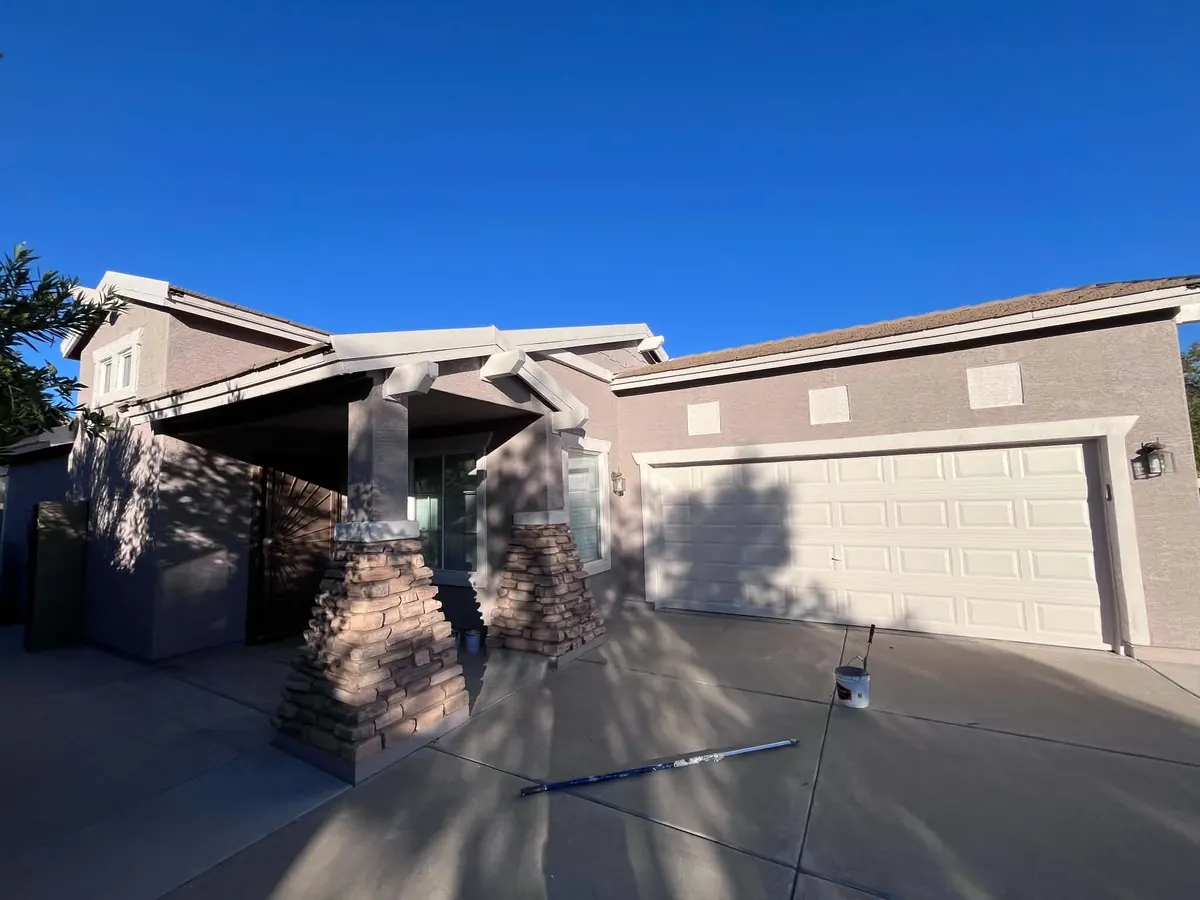
The name fits. Warm Stone sits close to the darker tones in many tan stone veneers, flagstone patios and the shadowed faces of split-face block. That makes it useful wherever paint meets a fixed material: column bases, a wainscot band below stone, and garden walls that run up to a paver patio.
Take the sample outside and hold it against the stone itself. If the stone carries gray or blue, Warm Stone may look too brown beside it. If the stone runs tan, gold and rust, it usually ties in.
Accent roles that suit it
- Base bands and wainscots on stucco, where a darker color hides dirt and splash-back from monsoon rain.
- Pop-outs, window surrounds and recessed panels on a light greige body.
- Garage doors and front doors on homes where black would feel harsh.
- Fascia and patio-cover beams on a light house.
- Block walls and planters beside desert landscaping.
Can it work as a full body color?
It can, with trade-offs. At an LRV near 20, a Warm Stone wall absorbs roughly four-fifths of the visible light that strikes it, so a west or south face gets much hotter than the same wall in a light greige. Heat speeds the breakdown of the paint film and puts more stress on caulked joints. Deep colors also show uneven fading sooner, especially where a tree or the neighbor's house shades half a wall.
If you love it on the whole house, it is more forgiving on a home with deep overhangs and covered patios than on a two-story west wall with no shade. Many HOAs also limit how dark a body color can be, so check before you plan around it.
Indoors: dens, fireplaces and cabinetry
Inside, Warm Stone gives a room an enclosed, earthy feel. It suits a den, study or media room, a fireplace wall framed by lighter walls, and lower cabinets or an island in a kitchen with cream counters. North light cools it toward taupe; west sun warms it toward cocoa.
In a small room with little daylight it can feel heavy, and a light ceiling and trim help a lot there.
Agreeable Gray and Incredible White
Sherwin-Williams lists Incredible White (SW 7028), Agreeable Gray (SW 7029) and SW 6192 as coordinating colors. Agreeable Gray, near 60 by our calculation, makes a light body for a Warm Stone base band or trim. Incredible White, at 227, 222, 215 and close to 74, makes a soft trim or upper-wall color. Both carry a little warmth, so the brown does not look muddy beside them.
- Brighter trim: Alabaster (SW 7008) for a warm white.
- A deeper door color: Urbane Bronze (SW 7048).
Lighter and darker neighbors
Dovetail (SW 7018), at 144, 138, 131 and near 26, is lighter and grayer: a similar depth range but cooler. Tiki Hut (SW 7509), at 130, 111, 94 and near 17, is a bit darker and clearly browner. Warm Stone sits between the two, with enough gray to stay calm and enough brown to look earthy.
Getting a deep taupe on evenly
Darker colors show every inconsistency, so application matters more. On stucco we prime bare or patched spots with Loxon masonry primer, then spray and back-roll two coats of Sherwin-Williams Emerald Exterior, working to a wet edge so the sheen stays uniform. Satin suits doors and trim; a lower sheen suits big walls. Inside, low-VOC Emerald Interior in eggshell or satin.
- Paint a large board and set it next to your stone, pavers or roof tile.
- Check it in direct sun and in shade.
- Ask your HOA whether Warm Stone is approved for the body, accents or both.
Frequently asked questions
- Is Warm Stone brown or gray?
- It is a taupe that leans brown. Red leads its RGB values clearly, so it looks warmer than a greige like Anonymous (SW 7046).
- Is Warm Stone too dark for an Arizona exterior?
- As a full sunny body it runs hot, with a calculated LRV of about 20. It is easier to live with on bands, pop-outs, doors and garden walls.
- What body color goes with Warm Stone accents?
- Agreeable Gray (SW 7029), one of its listed coordinating colors, is a common light body. Incredible White (SW 7028) works for trim.
- Does Warm Stone match stone veneer?
- It often matches tan and brown veneers and flagstone. Hold a sample against the stone, because gray stone can make it look too brown.
- Can Warm Stone be used on kitchen cabinets?
- Yes, especially islands and lower cabinets with light counters. Choose satin or semi-gloss so they wipe clean.
- Is Warm Stone darker than Dovetail?
- Yes. Dovetail (SW 7018) calculates near 26 and is grayer; Warm Stone is near 20 and browner.
- Does Warm Stone suit a garage door?
- It does on a light greige or beige house where black would feel heavy. A darker steel door heats up in afternoon sun, so it needs cleaning, priming and a quality exterior finish to last.