Paint color · Neutral charcoal
Grizzle Gray (SW 7068): A Balanced Charcoal for Desert Homes
Published
Grizzle Gray (SW 7068) is a dark charcoal from Sherwin-Williams that stays close to neutral, with only a whisper of green. Its LRV is about 12.8 when calculated from the RGB values, which makes it a strong choice for trim, doors, shutters and modern accent walls on Arizona houses, and a demanding one for a full sun-facing body.
Its appeal is that it rarely surprises you. Where many dark grays swing blue, green or brown as the light changes, Grizzle Gray stays recognizably charcoal.
Color swatch: Grizzle Gray SW 7068, #636562
| Color | Grizzle Gray |
|---|---|
| Code | SW 7068 |
| Hex | #636562 |
| RGB | 99, 101, 98 |
| LRV | About 12.8 (calculated from the RGB values) |
| Color family | Dark charcoal gray, close to neutral |
How neutral is Grizzle Gray?
Grizzle Gray's RGB values are 99, 101 and 98. The three channels sit within three points of each other, so the color is about as neutral as a dark gray gets. Green edges ahead by a hair, which can show as a faint olive or earthy note next to bright white or cool blue-grays.
Compared with Web Gray (SW 7075), which leans blue, Grizzle Gray is warmer and quieter. Compared with Homburg Gray (SW 7622), it has less green. That neutrality makes it easy to put next to almost any roof tile, stone or brick.
Grizzle Gray in hard sun and in north-facing rooms
In full Arizona sun, a Grizzle Gray stucco wall reads as a medium charcoal and shows every swirl of texture. In shade it reads close to soft black. On a two-story house, the shaded lower walls and sunny upper walls can look like two different colors at noon, which is normal for any dark color.
In north light indoors, it stays neutral and a little moody. Under warm bulbs it can lean faintly brown. It is a reliable choice for a TV wall, a home theater or a dark accent behind open shelving.
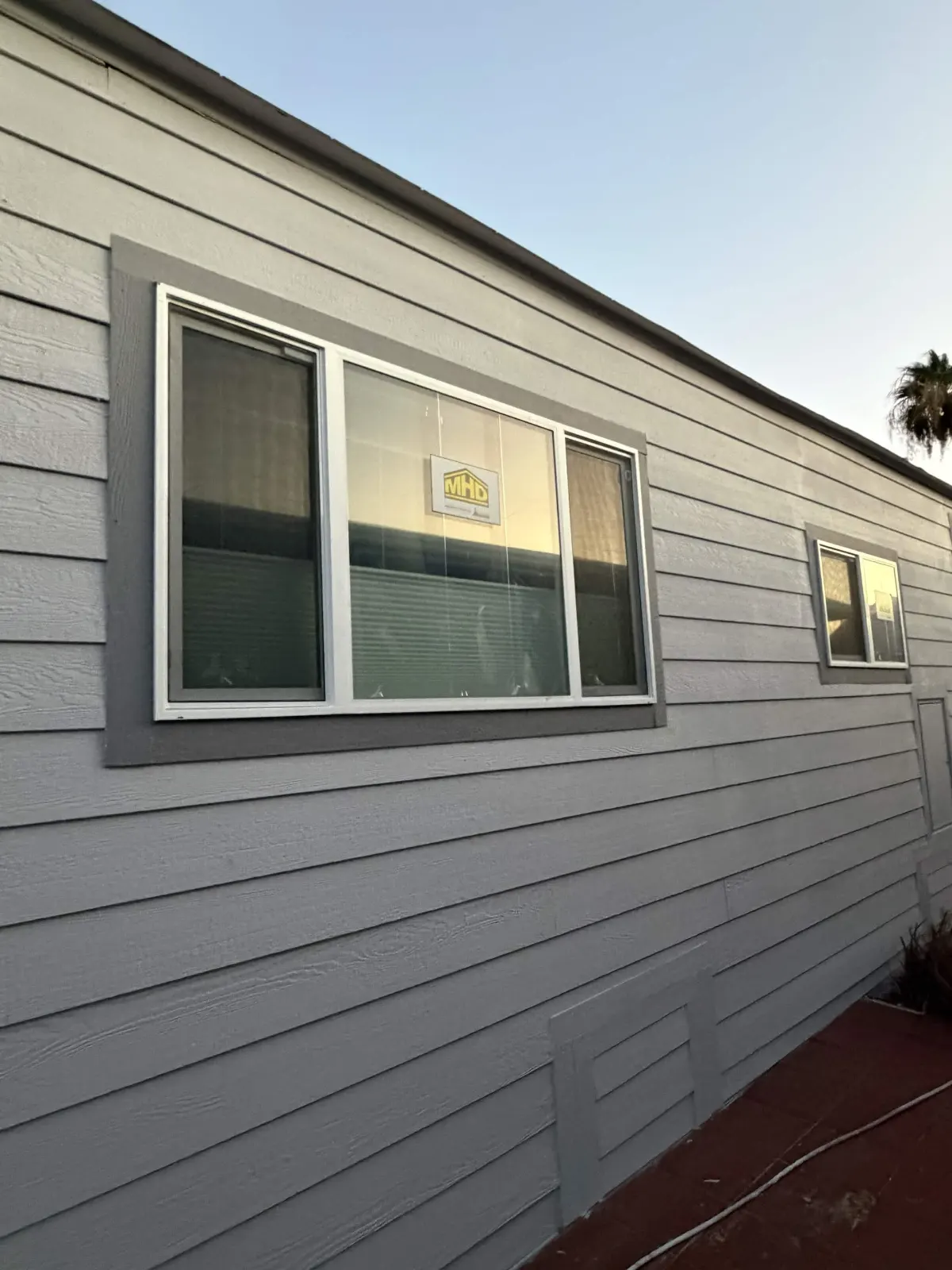
Where Grizzle Gray works
Grizzle Gray is less suited to a house where most of the trim is a warm almond, such as older vinyl windows, because the neutral charcoal next to almond can look slightly green. On white or black window frames, it looks crisp.
- Fascia, window trim and garage door trim on a light gray or off-white body
- Front doors, especially with brushed nickel or black hardware
- Shutters and gates
- Lower cabinets, islands and bathroom vanities
- Exterior body on contemporary homes with deep overhangs, accepting more heat
Pairings for Grizzle Gray
Sherwin-Williams lists Nebulous White (SW 7063) and Passive (SW 7064) as coordinating colors for Grizzle Gray, along with SW 6333. Nebulous White is the lighter of the two, close to an off-white at an LRV of about 73.5, while Passive is a pale cool gray around 60.
- Body with Grizzle Gray trim: Passive (SW 7064) or On the Rocks (SW 7671)
- Light trim or soffits: Nebulous White (SW 7063)
- Mid-tone body color with Grizzle Gray trim: Gray Matters (SW 7066)
- Even darker accent: Rock Bottom (SW 7062)
LRV around 13: heat and fading
At an LRV near 13, Grizzle Gray absorbs nearly 90 percent of visible light. A sunlit wall or door in this color gets much hotter than a light color, and hotter paint films wear faster through UV and thermal cycling.
Neutral charcoals are mostly black pigment, which tends to be stable, so they usually do not shift hue as they age. What you see instead is chalking and a slight lightening on sunny faces. A gentle wash often brings back depth before a full repaint is needed.
Grizzle Gray as a modern trim color
Dark trim on a light body has become a common look on Arizona stucco. Grizzle Gray is a gentler choice than black: it frames windows and rooflines clearly but softens slightly in sun, so it looks less harsh at midday. It also shows dust and bird droppings less than true black.
For a cohesive scheme, use Grizzle Gray on fascia, window pop-outs and the front door, keep the garage door the body color, and let a light trim color handle soffits. That way the darkest color lands on smaller surfaces, which limits heat and fading.
Sheen and product for Grizzle Gray
On stucco, we apply Sherwin-Williams Emerald Exterior in two coats, spraying and then back-rolling, with Loxon masonry primer on bare or patched areas. A flat finish suits body walls; satin is easier to clean on trim and doors.
For deep colors like this one, coverage over a lighter existing color may need more than two coats or a tinted primer. Inside, choose satin for cabinets and eggshell or matte for walls; dark colors show sheen differences and touch-ups more than light ones.
Testing Grizzle Gray
- Paint two coats on a large board and look at it in direct sun and in shade.
- Compare it beside your roof tile and window frames, since bronze or black frames change how it reads.
- Inside, check it under your own bulbs at night.
- For exterior use under an HOA, confirm that dark trim or body colors are allowed.
Frequently asked questions
- Is Grizzle Gray warm or cool?
- It is close to neutral, with green edging ahead slightly in its RGB values. In most light it reads as plain charcoal, occasionally with a faint earthy note.
- Is Grizzle Gray good for Arizona exterior trim?
- Yes, it frames windows and rooflines clearly without the harshness of black. At an LRV of about 13 it gets hot, which is easier to manage on trim than on full walls.
- What colors go with Grizzle Gray?
- Sherwin-Williams lists Nebulous White (SW 7063) and Passive (SW 7064) as coordinating colors. Light grays like On the Rocks (SW 7671) also work as a body color.
- How does Grizzle Gray compare with Rock Bottom?
- Rock Bottom (SW 7062) is darker, with an LRV of about 7, and reads closer to near-black. Grizzle Gray is lighter and more neutral.
- Can Grizzle Gray be used on kitchen cabinets?
- Yes, it suits islands and lowers, especially with white or light quartz counters. A satin finish keeps them easy to wipe.
- Will Grizzle Gray fade in Arizona sun?
- Neutral charcoals tend to hold their hue, but they will chalk and lighten slightly on sunny walls over time. Shaded surfaces keep their depth longer.