Paint color · Sherwin-Williams beige
Loggia (SW 7506): A Sandy Mid Beige for Arches, Patios and Tile Roofs
Published
Loggia (SW 7506) is a mid-depth sandy beige: warm, slightly golden and muted enough to look natural on stucco. It has the right weight for a whole-house body color in Arizona, where lighter beiges can wash out in the sun.
Its hex is #C4B7A5, and the LRV comes to about 48 when calculated from the RGB values. That is the middle of the scale, deep enough to read as a real color from the street and light enough to stay reasonable on a hot wall.
Color swatch: Loggia SW 7506, #C4B7A5
| Code | SW 7506 |
|---|---|
| Hex | #C4B7A5 |
| RGB | 196, 183, 165 |
| LRV | About 48 (calculated from RGB) |
| Color family | Neutral, per Sherwin-Williams; a warm, sandy mid beige |
Sand, not pink: the numbers behind Loggia
Loggia's channels are 196 red, 183 green and 165 blue. Red leads green by 13 and green leads blue by 18. The larger second step is the yellow component, and it is why Loggia reads as sand or warm stone rather than as a rosy taupe.
Balanced Beige (SW 7037) is the color most people compare it with. At 192, 178, 162 it is a few points darker, and its red-to-green step is a touch larger, which gives it a faint rosy cast that Loggia mostly lacks. Macadamia (SW 6142), at 204, 183, 155, goes the other way: a much bigger drop to blue makes it a clear golden tan.
A name that fits Mediterranean homes
A loggia is a covered gallery open on one side, the arched porch you see on Italian and Spanish buildings. Many West Valley houses borrow that look: arched entries, columns, deep covered patios and clay-colored tile roofs. Loggia suits that architecture well, because a sandy mid beige is close to the plaster and stone those styles imitate.
It also works on simpler ranch and production homes. On a plain facade it gives a warm, settled look without the yellow cast of a stronger tan.
How arches and covered patios change the color
Covered spaces always look a step darker than the open walls around them. On a Loggia house, the walls inside an arched entry or under a patio cover will read closer to a taupe, while the sunny walls read as a light sand. Seen together, the two tones give the facade depth without a second paint color.
If you want the covered areas to feel brighter, paint the patio ceiling in a light off-white rather than in the body color. Patio ceilings and soffits catch reflected light from the ground, and a pale ceiling bounces it back down.
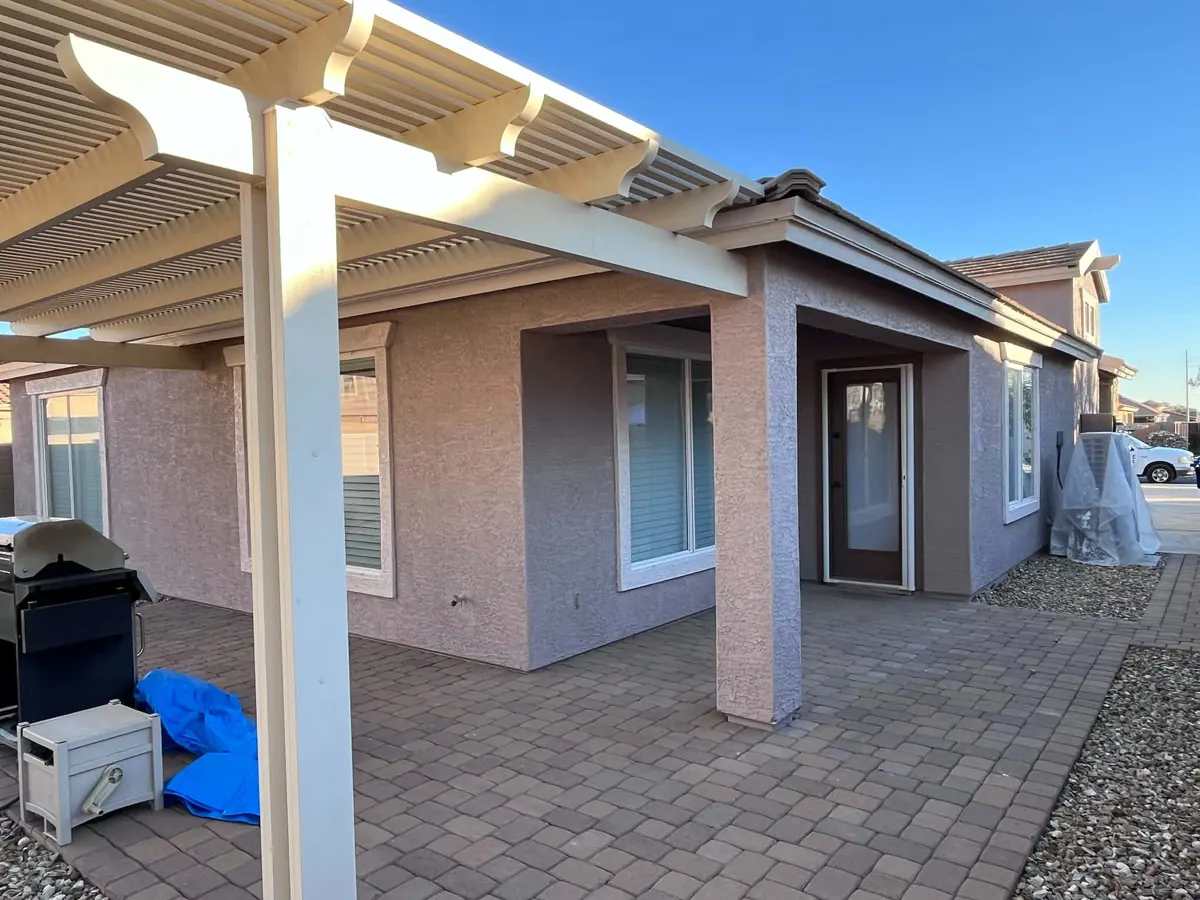
Roof tile, stone and pavers
- Terracotta or red clay tile: Loggia's sandy base keeps the roof looking warm without competing with it.
- Brown or blended concrete tile: a comfortable, earthy match; add a deeper trim so the roofline does not blur into the walls.
- Charcoal or gray tile: workable, but the pairing reads more neutral; check the sample against the roof in afternoon light.
- Stone veneer and travertine pavers: the beige picks up the lighter stones and lets the darker ones stand out.
Trim and accents with Loggia
Sherwin-Williams lists Aesthetic White (SW 7035), SW 9174 and SW 0006 as coordinating colors. Aesthetic White, at 227, 221, 211, is a soft warm off-white with a calculated LRV near 73. On fascia, window surrounds and pop-outs it gives Loggia a clean edge without the stark jump of a bright white.
For a darker accent, a warm taupe or bronze on the garage door, shutters and front door gives the house a focal point. Two-tone schemes also work: Loggia on the main body with a lighter beige on pop-outs and arches, or the reverse.
Loggia indoors
Inside, Loggia is a warm, enveloping wall color for great rooms, dens and dining rooms with wood, leather and wrought iron. It is too deep for a small, dark room, where it can feel heavy.
North-facing rooms pull it toward a grayish taupe. South and west rooms bring out the golden sand. Pair it with a soft white ceiling and trim so the room keeps some lift.
Surface heat and sun wear at LRV 48
At about 48 by our calculation, Loggia reflects a little under half the visible light that hits it. A west wall in Loggia will run warmer than one in a light greige, though far cooler than a brown or charcoal body. If heat is a concern, keep Loggia on the main body and use a lighter color on the most exposed elevation.
Mid-tone earth colors age gracefully. Years of UV usually show as a slight, even lightening on south and west walls, and because Loggia is muted rather than saturated, the change is gradual. Good prep and a top-tier exterior paint slow it down further.
Applying and testing Loggia
Stucco bodies get two coats of Sherwin-Williams Emerald Exterior, sprayed and back-rolled, with Loxon masonry primer on bare or patched areas. A flat finish suits the body because it hides texture variation; satin suits doors and trim.
- Paint one sample on an open, sunny wall and one inside an arch or under the patio cover.
- Compare both against your roof tile from the street.
- Hold Aesthetic White and your accent color beside the sample to judge the full scheme.
- If your HOA has an approved palette, check that Loggia is on it or submit it before work is booked.
Frequently asked questions
- Is Loggia beige or taupe?
- It is a warm, sandy beige. In shade and under covered patios it can look closer to taupe, but its undertone leans yellow rather than pink or gray.
- How does Loggia compare with Balanced Beige?
- They are close in depth. Loggia is slightly lighter, with a calculated LRV of about 48 against about 46, and it reads sandier, while Balanced Beige has a faint rosy taupe quality.
- Does Loggia work with a red tile roof?
- Yes. Its sandy warmth sits comfortably under terracotta and clay tile, which suits the Mediterranean style of many West Valley homes.
- What trim color goes with Loggia?
- Aesthetic White (SW 7035), one of the listed coordinating colors, is a soft warm off-white that keeps the scheme gentle. A warm taupe or bronze works for doors and garage doors.
- Will Loggia look too dark on a stucco house?
- In full sun it looks lighter than the chip, more like a light sand. It deepens in shade, which gives the house dimension rather than making it heavy.
- Is Loggia a good color for a patio ceiling?
- It can work, but a patio ceiling in shade will look darker than the walls. A light off-white ceiling usually keeps a covered patio feeling brighter.