Guide · Stucco · Application
What Back-Rolling Is and Why It Matters on Stucco
By the Orange Coatings team · Published
Back-rolling is rolling over paint right after it is sprayed, while it is still wet, so the roller presses the paint into the surface instead of letting it sit on top. On stucco it matters because spray alone bridges over the pits and pores in the texture, leaving pinholes and thin spots that let water and sun get to the wall and shorten the paint's life.
This guide explains what actually happens on the wall, how a two-person spray and back-roll team works, where Arizona heat makes it harder, and the questions that tell you whether a bid includes it.
Back-rolling in plain terms
An airless sprayer breaks paint into fine droplets and lays a wet film on the wall fast. A thick-nap roller then follows a few feet behind, rolling through that wet film. The roller does not add much paint. It moves the paint that is already there, pushing it down into low spots and evening out heavy and light areas before the coat starts to set.
The term only applies when the rolling happens on wet, just-sprayed paint. Rolling a second coat over a dry first coat is ordinary rolling, and spraying a coat and walking away is spray-only application.
What spray alone misses on stucco
Stucco is full of small craters, sand grains, ridges and air pockets. Spray droplets land on the high points first and can skip across the openings of tiny pores, leaving a skin of paint stretched over a void. From the street the wall looks covered. Up close, in low sun, you see pinholes: tiny dark dots where the stucco is bare or barely coated.
Sherwin-Williams' own data sheet for its Loxon XP masonry coating says to spray and backroll porous and rough stucco to reach the required film build and a pinhole-free surface. That is the whole case for back-rolling in one line: enough paint on the wall, and no holes in it.
Why pinholes matter in the desert
- Each pinhole is a spot where monsoon rain and sprinkler water reach the stucco directly instead of hitting a continuous film.
- Thin areas around pinholes have less paint for UV to wear through, so they chalk and fade first.
- Moisture that gets in behind the film through pinholes can push paint off in blisters during summer heat.
- Dirt and dust settle into the open pores, so a pinholed wall looks dingy sooner.
How a crew sprays and back-rolls
On a stucco house the work is usually done by two people moving together along one wall: one sprays a section, and the other rolls it right away. The sprayer works top to bottom in manageable widths so the roller is never more than a few feet behind. The roller uses a thick nap, because a short-nap roller cannot reach into a sand or lace texture.
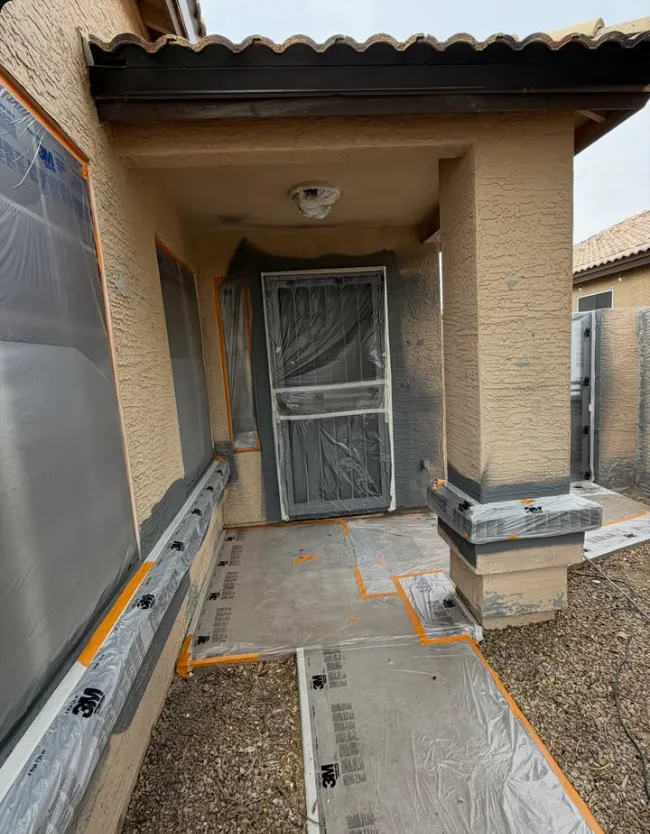
Masking comes first, since overspray drifts. Windows, doors, light fixtures, walkways and plants are covered before the sprayer starts, and trim is often painted separately by brush and roller.
- Spray a section of wall from top to bottom.
- Back-roll the same section immediately, working the paint into the texture.
- Overlap into the previous section while it is still wet to avoid lap lines.
- Finish the whole wall to a natural break, such as a corner or a control joint.
- Let the coat dry for the recoat time on the label, then repeat for the second coat.
Arizona heat makes timing tight
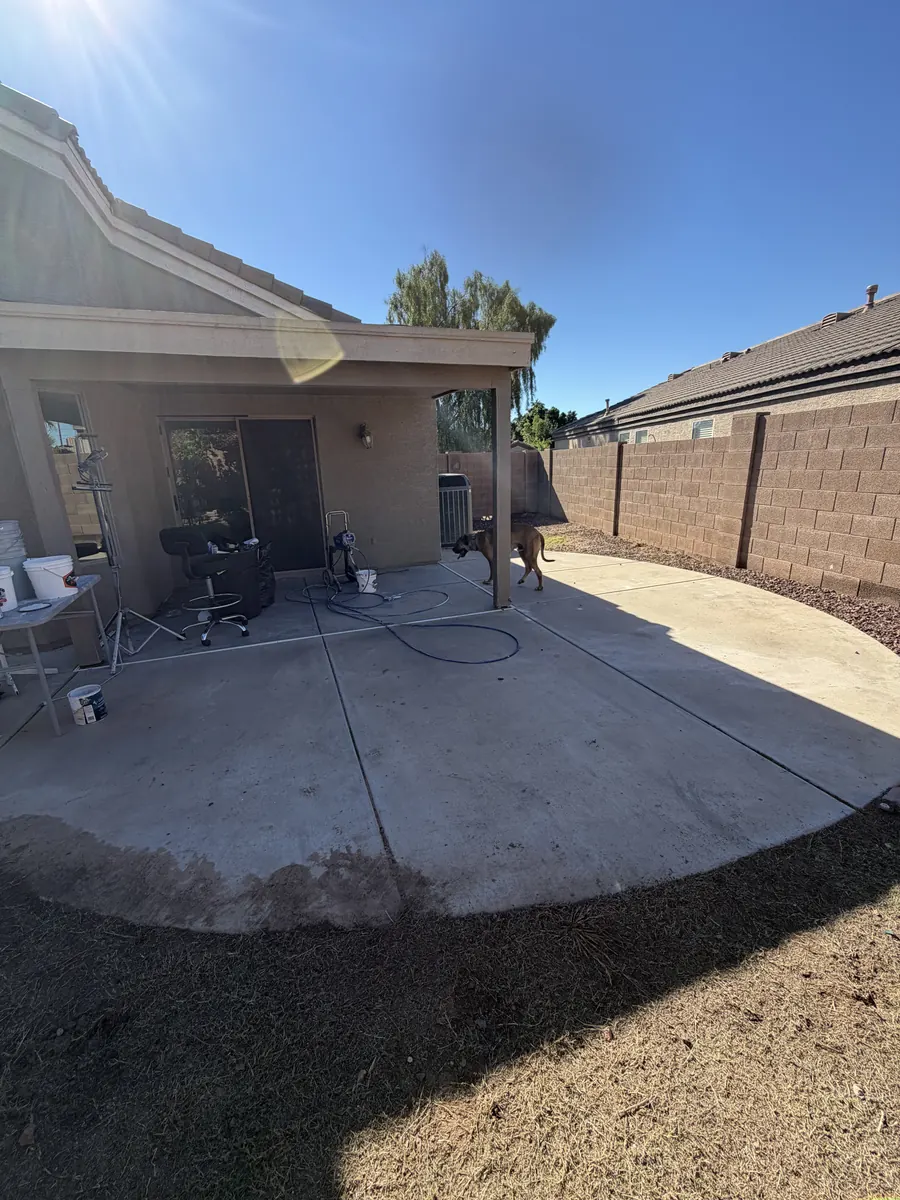
Back-rolling only works while the sprayed paint is wet. On a hot, dry afternoon in the West Valley, paint on a sun-baked wall can start to skin within minutes. If the roller falls behind, it drags partly dry paint, leaving roller marks, ridges and a rougher surface than spraying alone.
Crews handle this by following the shade around the house, keeping sections small on sunny walls and starting early in summer. Each product's label also lists a surface temperature range, and staying inside it matters more than speed.
Different stucco textures, different results
- Sand finish: the most common texture here. Back-rolling makes the biggest difference because of the many small pores.
- Lace or skip-trowel: deep valleys between flat tops. The roller has to push paint into the low areas without flattening the look.
- Smooth or Santa Barbara finish: fewer pores, but back-rolling still evens out film thickness and spray lines.
- Patched areas: new patch material is more porous than the old wall and soaks paint in unevenly, which is why patches get primer first.
What back-rolling cannot fix
It is an application method, not a repair. It will not hold paint on a chalky, dirty or wet wall, and it will not bridge a crack that is moving. Washing, crack repair and primer on bare stucco come first. On bare or patched stucco we use Sherwin-Williams Loxon masonry primer, then two coats of Emerald Exterior, each one sprayed and back-rolled.
How to tell if your painter back-rolls
Ask directly, and ask for it in writing: "Will every coat on the stucco be sprayed and back-rolled?" Then watch on the first day. If you see only a sprayer moving along the wall and no one following with a roller, ask about it right away. At the final walkthrough, shine a flashlight across a few walls at a low angle and look for pinholes, especially near the ground and around window trim.
Frequently asked questions
- Is back-rolling the same as rolling the whole house by hand?
- No. Rolling alone is slow on stucco and can leave thin coverage in deep texture. Back-rolling combines the speed and coverage of a sprayer with the pressure of a roller.
- Does back-rolling use more paint?
- Not much more. The roller mostly redistributes the sprayed paint, though a properly built film on stucco uses more paint than a thin spray-only coat, which is the point.
- Do both coats need to be back-rolled?
- On stucco, yes. The second coat has its own thin spots and pinholes to close, and back-rolling it gives the final surface its even look.
- Should elastomeric coatings be back-rolled too?
- Usually, because they go on thick and are meant to form a continuous membrane. Follow the product's data sheet for the application method and film thickness.
- Can back-rolling leave roller marks on stucco?
- It can if the roller drags paint that has started to dry, which happens in direct afternoon sun. Keeping the roller right behind the sprayer and working in shade prevents it.
- Is spray-only ever fine on stucco?
- For very smooth, previously sealed surfaces it can look acceptable, but it rarely builds the same film on textured stucco. On a typical sand-finish wall, we would not skip the roller.