Guide · Epoxy flooring
Why Garage Epoxy Peels in Arizona (and How to Stop It)
By the Orange Coatings team · Published
Garage epoxy in Arizona almost always peels because the bond to the concrete failed: the slab was not ground or profiled, moisture pushed up from below, the coating was a thin DIY kit, or hot tires pulled it loose. Summer makes the tire problem worse, since tires come home very hot after a drive across the Valley and soften whatever they park on.
The good news is that each cause is preventable with prep, testing and the right product. Below are the five common failures, how to tell which one hit your floor, and what a garage floor that lasts is built from.
1. Hot tire pickup
Tires heat up on the road, then sit on the coating as they cool. A hot tire softens the surface it rests on, and as the rubber cools and contracts it grips the coating. When you back out, the tire can lift the coating with it. The damage shows up as peeled patches in the shape of tire tracks, usually where you park every day.
Coating chemistry matters here. Highly cross-linked coatings such as epoxies, polyurethanes and polyureas resist hot tire pickup much better than single-pack acrylic or alkyd floor paints. Even a good epoxy will let go if it is thin or sitting on poorly prepared concrete, so pickup is often a prep problem showing up under a tire.
2. Prep that was skipped or too light
Epoxy has to grip the concrete, and it can only grip a surface that is open, clean and slightly rough. A smooth troweled slab, an old clear sealer, oil soaked in where a car leaked, tire residue and fine dust all keep it from bonding. Acid etching opens the surface a little. Mechanical grinding opens it properly and removes contaminants, and it is the starting point for a floor meant to last.
Oil spots need degreasing before grinding, and cracks and divots need filling so the coating does not bridge over voids.
3. Moisture moving up through the slab
Concrete is porous and holds water. When moisture vapor rises through a slab and meets a coating, it can blister the film and break the bond from underneath. Older slabs and slabs poured without a vapor barrier are the usual candidates, and so are garages next to irrigated beds.
A simple check is the plastic sheet method described in ASTM D4263: tape a square of clear plastic tightly to the bare concrete, leave it for about a day, and look underneath. Darkened concrete or droplets mean the slab is giving off moisture, and it needs drying time or a moisture-mitigating primer before coating.
4. A thin kit instead of a floor system
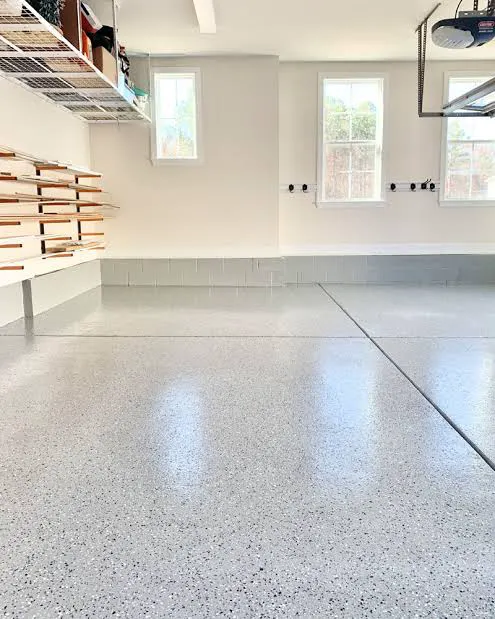
Big-box garage kits put down a much thinner film than a professional floor system. They often look good at first, then wear through in the turning areas, scuff where tires pivot and lift where cars park. A floor system builds thickness in layers: a base coat bonded to ground concrete, an optional broadcast of decorative flakes, and a clear topcoat that takes the wear.
5. Coating in the wrong conditions
An Arizona garage in summer can be hotter than the outside air by afternoon, and the slab holds that heat. Heat shortens the working time of epoxy, so it can start to set before it levels and wets out the concrete. Coating in the cooler early hours, inside the temperature range on the product label, gives the material time to flow and bond. Monsoon humidity matters too: high humidity during application can affect how some coatings cure.
Which failure hit your floor?
- Peeling in tire shapes, bare gray concrete underneath: hot tire pickup on a weak bond.
- Large sheets lifting with clean, smooth concrete on the back: poor prep or a sealer the coating never stuck to.
- Blisters, or white powder on the underside of loose pieces: moisture or salts coming up through the slab.
- Worn-through paths and scuffing in turning lanes: a coating too thin for vehicle traffic.
- Topcoat peeling off a base coat that is still firmly attached: the topcoat went on outside the base coat's recoat window or over a contaminated surface.
Can a peeling floor be fixed?
Usually, but not with patches. A coating that has let go in one spot is often weak in others, and a patch line will show through flakes and gloss. The repair is to remove the loose and failing coating, grind the slab back to sound, open concrete, deal with any moisture, repair cracks, and recoat the whole floor so the bond is the same everywhere.
What a garage floor that lasts looks like
- Concrete cleaned, degreased and ground so the coating bonds, with cracks and divots repaired
- A moisture check on older slabs, and a moisture-mitigating primer where it is needed
- A Sherwin-Williams epoxy floor system in your choice of color
- Optional decorative flakes broadcast into the base coat to hide dust and tire marks
- A clear topcoat over the flakes to take the wear
- Optional anti-slip additive for entries and wet areas
- Application in the cooler part of the day, with the cure time explained before you park
Frequently asked questions
- How soon can I park on a new epoxy garage floor?
- Foot traffic comes first and cars come later. Most epoxy garage floors take foot traffic in about a day and vehicles in about three days, depending on the system and the temperature, and we give you the cure times for your floor at the estimate.
- Do decorative flakes make the floor stronger?
- Flakes mainly add texture and hide dust, tire marks and small imperfections. The clear topcoat over them is what takes the wear.
- Is epoxy a good idea in a hot Arizona garage?
- Yes, with real surface prep and a professional system applied in the cooler part of the day. Most failures trace back to prep and product rather than the climate itself.
- Will parking right after a long summer drive damage a good epoxy floor?
- A well-bonded professional system is made to handle hot tires once it has fully cured. Tires may still leave dark marks, which clean off with regular care.
- Why is my garage epoxy bubbling instead of peeling?
- Bubbles and blisters usually point to moisture or vapor coming up from the slab, or to air escaping from porous concrete during application. Moisture testing before coating is how that is prevented.
- Is epoxy or polyaspartic better for an Arizona garage?
- Both can work well when the concrete is properly prepared. They differ in cure speed, working time and UV resistance; our comparison of the two covers the trade-offs in Arizona heat.