Guide · Epoxy flooring
Epoxy vs Polyaspartic Garage Floors in Arizona Heat
By the Orange Coatings team · Published
In an Arizona garage, epoxy is the stronger choice for the thick, well-bonded base layer, and polyaspartic is the stronger choice where sunlight and fast return to service matter, because it resists UV yellowing and cures in hours. That is why many durable garage floors use both: an epoxy base, often with decorative flakes, under a clear, UV-stable topcoat.
The heat matters to both. A hot slab and a hot garage shorten how long either product can be worked, so timing and prep decide the result as much as the chemistry does.
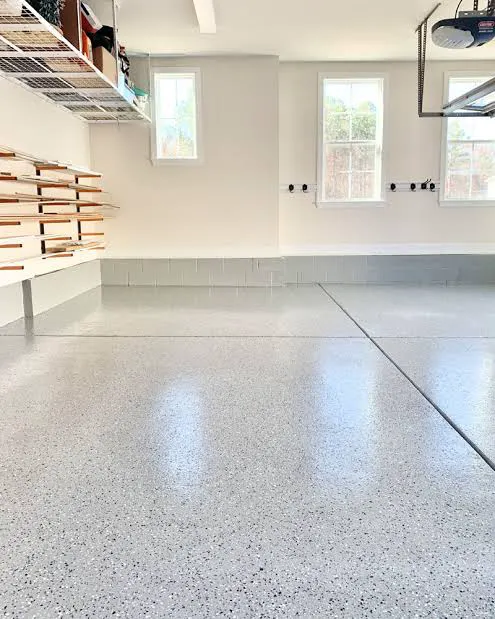
What each coating is
Epoxy is a two-part resin and hardener that cures into a hard, thick film. It wets into properly prepared concrete, bonds strongly, and builds up quickly, which makes it a good base for a garage floor system and for broadcast flakes.
Polyaspartic is also a two-part coating, from the urethane family of chemistry. Sherwin-Williams lists UV-resistant, color-stable protection among its benefits and says coats can cure in as little as a couple of hours. It can be used as a full system or applied over an epoxy base as the wear layer.
Side by side
- Sunlight: standard epoxy tends to amber or yellow with UV exposure; polyaspartic is UV-stable and holds its color and clarity.
- Cure and return to service: epoxy usually needs about a day for foot traffic and longer for cars; polyaspartic cures much faster.
- Working time: epoxy gives the installer more time to spread and level; polyaspartic sets quickly and leaves little room for error.
- Build: epoxy goes on thick and fills minor surface flaws; polyaspartic coats are often thinner.
- Cost: polyaspartic materials are generally priced higher than standard epoxy.
- DIY friendliness: neither is truly easy, but polyaspartic's short working time makes it a poor first DIY project.
Why sunlight is the deciding factor in many Arizona garages
A garage door that faces west and stays open on summer afternoons lets hard UV light reach the first few feet of floor. Standard epoxy in that zone can darken and turn amber over time, while the back of the garage stays its original color. On a light gray or white floor, that line becomes obvious.
A UV-stable topcoat over the epoxy prevents most of that. If your garage door stays closed most of the day, or faces north, ambering is less of a concern. Some manufacturers also make epoxies formulated to resist ambering; Sherwin-Williams, for example, sells a clear epoxy it describes as having improved UV resistance.
How heat affects installation
Every two-part coating starts curing the moment it is mixed, and heat speeds that reaction up. In a garage that reaches well over 100 degrees on a summer afternoon, an epoxy's working time shrinks, and a polyaspartic's already short window can shrink to the point where it is hard to apply evenly. Coating a hot slab can also lead to bubbles, lap marks and a weaker bond.
The fix is timing. Installs in summer start in the early morning, when the slab is coolest, and stay inside the temperature and humidity limits on the product's data sheet. Spring, fall and winter are the easiest seasons for garage floors in the Phoenix area.
Hot tires and either coating
Hot tire pickup, where a tire softens the coating and pulls it up as it cools, is the most common garage floor failure in Arizona. It is mostly a prep and thickness problem, not a choice between two chemistries. A floor that is ground or profiled, cleaned and coated with a professional-grade system holds up; a thin coating rolled onto smooth, dusty concrete lets go, whatever it is made of.
What we install
For garages we install Sherwin-Williams epoxy floor systems, and the concrete gets cleaned, degreased, crack-repaired and profiled before any coating goes down. Decorative flakes are optional, a clear topcoat goes over them to take the wear, and an anti-slip additive can be added for entries and areas that get wet. We set the schedule around temperature and humidity so the coating cures correctly, and we give you foot-traffic and parking times for the specific system at your estimate.
Living with each floor
Day-to-day care is similar. Both kinds of floor clean up with a dust mop, a soft-bristle broom and a mild cleaner, and both resist oil and most household chemicals once fully cured. Neither likes being dragged on with sharp metal, so put pads under jack stands and tool-chest casters.
The difference shows over years in a sunny garage. An epoxy surface without a UV-stable topcoat may slowly change color near the door, while a polyaspartic top layer keeps a more even look. When a topcoat eventually wears in the traffic lanes, a clean, scuffed floor can usually be given a fresh clear coat without starting over from bare concrete.
Which one fits your garage
- Note which way your garage door faces and how often it stays open in daylight.
- Decide how quickly you need the garage back; a fast-cure topcoat shortens downtime.
- Choose a color; light solid colors show ambering more than flake blends.
- Have the slab checked for moisture, cracks, old sealers and oil before choosing a system.
- Ask any installer which product is the base, which is the topcoat, and what their data sheets say about heat.
Frequently asked questions
- Is polyaspartic better than epoxy for an Arizona garage?
- Not on its own. Polyaspartic wins on UV stability and cure speed, while epoxy builds a thicker base and gives a longer working time. A combined system often gets the best of both.
- Will an epoxy garage floor turn yellow?
- Standard epoxy can amber where sunlight reaches it, usually near the garage door. A UV-stable clear topcoat greatly reduces this.
- Can a coating be installed in summer in Phoenix?
- Yes, but early in the day and within the product's temperature limits. Heat shortens working time, so summer installs need careful scheduling.
- How long before I can park on the new floor?
- It depends on the system and the temperature. Epoxy systems usually need a few days before cars, while fast-cure topcoats can shorten that; your installer should give you the times for the products used.
- Do flakes work with both coatings?
- Yes. Flakes are broadcast into a wet base coat and locked in with a clear topcoat, and both epoxy and polyaspartic systems are offered with flake blends.
- Does polyaspartic stop hot tire pickup?
- Good chemistry helps, but prep and film thickness matter most. A well-prepared, profiled slab with a professional system is what resists hot tires.