Guide · Epoxy flooring
Garage Floor Paint vs. a Real Epoxy Coating
By the Orange Coatings team · Published
Garage floor paint is a single-component coating, usually latex acrylic, that dries as the water evaporates and leaves a thin film on the concrete. A real epoxy coating is a two-part system: a resin and a hardener that react chemically once mixed, cure into a much harder film, and are built up in layers over ground, cleaned concrete.
The confusion comes from labels. Plenty of cans say "epoxy" on the front and are still one-part paints with a little epoxy resin added. Below is how to tell the difference, how each one behaves in a hot Arizona garage, and when plain floor paint is actually a reasonable choice.
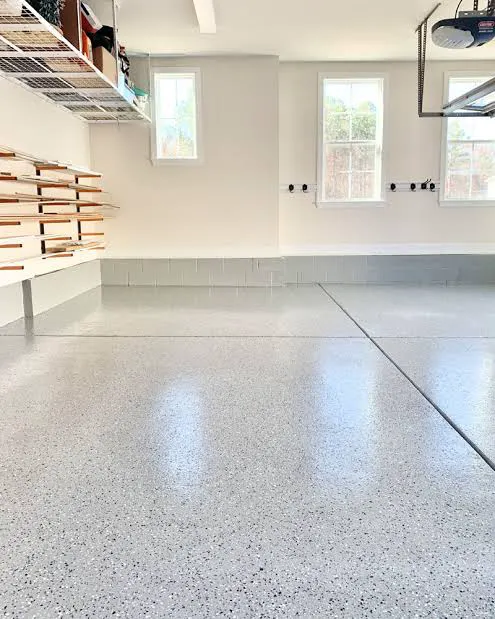
What is actually in each product
Concrete Network sorts the options into three groups. Latex acrylic floor paint is a water-based paint made for concrete. One-part epoxy paint is basically that same latex acrylic with a small amount of epoxy resin added for toughness. A two-part epoxy coating combines an epoxy resin with a separate hardener, and the two react to form the film.
That reaction is the whole difference. Paint hardens because its liquid leaves. Two-part epoxy hardens because its molecules link together into a tight network, which is why it resists hot tires, oil and abrasion far better once it has fully cured.
How to read the label in the store
Ignore the big word on the front and look for these clues on the back or the data sheet:
- Two containers, or a can marked Part A and Part B, with a mix ratio: two-component coating
- A pot life or working time listed after mixing: the material is reacting and has to be used within that window
- One can, stir and apply, cleans up with soap and water: almost always a one-part paint, whatever the front says
- Recoat windows listed as a minimum and a maximum time: typical of reactive floor systems, where the next layer has to bond chemically
- A data sheet that lists film thickness per coat: a sign the product is meant to be built up, not just rolled on once
What an Arizona garage does to floor paint
A West Valley garage is close to the worst case for a thin paint film. Summer heat softens it, cars come home with hot tires and park in the same two spots every day, and fluids drip onto a surface that is already warm. Concrete Network notes that latex floor paint can peel up from hot car tires and be softened by harsh chemicals such as gasoline and brake fluid.
Desert grit adds to it. Fine sand tracked in on tires works like sandpaper in the turning lanes, and a single thin coat has very little to lose before bare concrete shows through. A two-part system has more film to wear and a harder surface to wear it.
How long each one lasts
Concrete Network gives rough life spans that match what we see on West Valley floors: latex floor paint often needs redoing within a year or two, one-part epoxy paint lasts at least three to four years, and a properly installed two-part epoxy coating can go 15 years or longer. The word doing the work there is "properly." A two-part product rolled onto smooth, dusty concrete will fail much sooner, and most early failures we are asked to fix trace back to prep rather than to the product.
So the honest comparison is not paint against epoxy. It is a quick coat of paint against a prepared, layered floor system.
When plain floor paint is a fair choice
Paint is not always the wrong answer. It can make sense where cars never park and the floor just needs to look clean:
- A storage room, shed or casita floor with light foot traffic
- A garage used only as a workshop or gym, where no vehicles sit on it
- A short-term refresh when a full floor system is planned later
- Concrete that is too damaged to justify a coating until it is repaired or replaced
Going from a painted floor to epoxy
This is the part that catches people. Epoxy cannot be put over old floor paint and expected to hold, because the new coating would only be as strong as the paint's grip on the concrete. If that paint is already lifting under the tires, the epoxy will lift with it.
The old paint has to come off. On most garages that means mechanical grinding until the concrete is bare and open, then degreasing anything that soaked through, filling cracks and divots, and checking older slabs for moisture. It adds a step, which is one reason it pays to choose the long-term system the first time.
What a professional epoxy floor includes
For garages we install Sherwin-Williams epoxy floor systems, and the system starts with the concrete, not the coating.
- Clean and degrease the slab, including oil spots in the parking lanes.
- Repair cracks and divots so the coating is not bridging voids.
- Profile the surface so the epoxy bonds mechanically to the concrete.
- Apply the base coat in your chosen color.
- Broadcast decorative flakes into the wet base coat if you want them.
- Finish with a clear topcoat, with an anti-slip additive for entries and wet areas if needed.
Questions to ask before you buy either
- Is this a one-part or two-part product, and where does the data sheet say so?
- How will the concrete be prepared: a wash and etch, or grinding?
- What happens to any old paint or sealer already on the floor?
- How many layers go down, and is there a clear topcoat?
- When can I walk on it, and when can I park on it?
- What does the product's data sheet say about application temperature in a hot garage?
Frequently asked questions
- Is one-part epoxy paint the same as an epoxy floor?
- No. One-part epoxy paint is a latex acrylic paint with some epoxy resin added, and it dries rather than cures chemically. A two-part epoxy floor mixes a resin with a hardener and is applied as a layered system.
- Can I put epoxy over my painted garage floor?
- Not reliably. The old paint has to be ground off so the epoxy bonds to bare concrete; otherwise the new floor is only as strong as the old paint's grip.
- Why did my garage floor paint peel where I park?
- Hot tires soften a thin paint film and pull it up as they cool, and parking spots take that stress every day. Poor prep under the paint makes it happen sooner.
- Is garage floor paint easier to touch up than epoxy?
- It is easier to roll on again, which is why people keep repainting. A well-bonded epoxy floor needs touching up far less often, and a worn topcoat can usually be renewed without starting over.
- Does epoxy need more prep than paint?
- Both need clean, sound concrete, but a two-part system is expected to last many years, so it is installed over ground concrete with cracks repaired. That prep is a big part of why it lasts.
- Which is better for a garage I only use as a gym?
- Without cars and hot tires, paint can be a fair short-term choice. If you drop weights or roll heavy equipment, a two-part system with a clear topcoat holds up much better.
Related
- Epoxy flooring
- Flake epoxy garage floors
- Metallic epoxy floors
- Epoxy flooring in Surprise, AZ
- Epoxy flooring in Sun City West, AZ
- Epoxy flooring in Avondale, AZ
- Epoxy vs polyaspartic in Arizona heat
- Why garage epoxy peels in Arizona
- Garage door painting
- Can You Put Epoxy Over a Cracked Garage Floor?
- How to Prep an Oil-Stained Driveway Before It Gets Coated