Paint color · Sherwin-Williams white
Divine White (SW 6105): A Beige-Backed White for Sun and Stucco
Published
Divine White (SW 6105) is a warm off-white with a clear beige backbone. It reads as white in a room or on a wall, but it never turns stark, which makes it one of the easier whites to live with on a sunny Arizona house.
Its hex is #E6DCCD and its LRV works out to about 72 from the RGB values. That is bright enough to keep a wall cool and fresh, and low enough that a full south elevation does not throw hard glare back at the street.
Color swatch: Divine White SW 6105, #E6DCCD
| Code | SW 6105 |
|---|---|
| Hex | #E6DCCD |
| RGB | 230, 220, 205 |
| LRV | About 72 (calculated from RGB) |
| Color family | White, per Sherwin-Williams; a warm off-white with a soft beige base |
Where Divine White sits among the warm whites
The numbers step down evenly: red 230, green 220, blue 205. Red ahead of green by 10 adds a hint of peach, and the 25-point drop from red to blue is what gives it the beige base. Put simply, this is a white that has been warmed with a little sand rather than with yellow.
That places it in a useful middle spot. Antique White (SW 6119) has the same red but a lower blue of 198, so it looks creamier and more yellow. Shoji White (SW 7042) runs 230, 223, 211, a tighter spread that makes it softer and slightly grayer. Divine White is warmer than Shoji and less golden than Antique White.
A white body color that is easy on the eyes
Very bright whites, with LRVs in the mid 80s, bounce so much midday light that a whole sunlit facade can be uncomfortable to look at. Divine White gives up about a dozen points of reflectance against those whites, and you notice it as comfort, not as dinginess. In direct sun the beige base mostly disappears and the house reads as a clean, warm white.
In the shade of a covered entry, under deep eaves or on a north wall, the beige comes back and the color looks like a soft linen. That shift is a good thing on stucco: it gives the texture some depth instead of the flat, bleached look a brighter white can have.
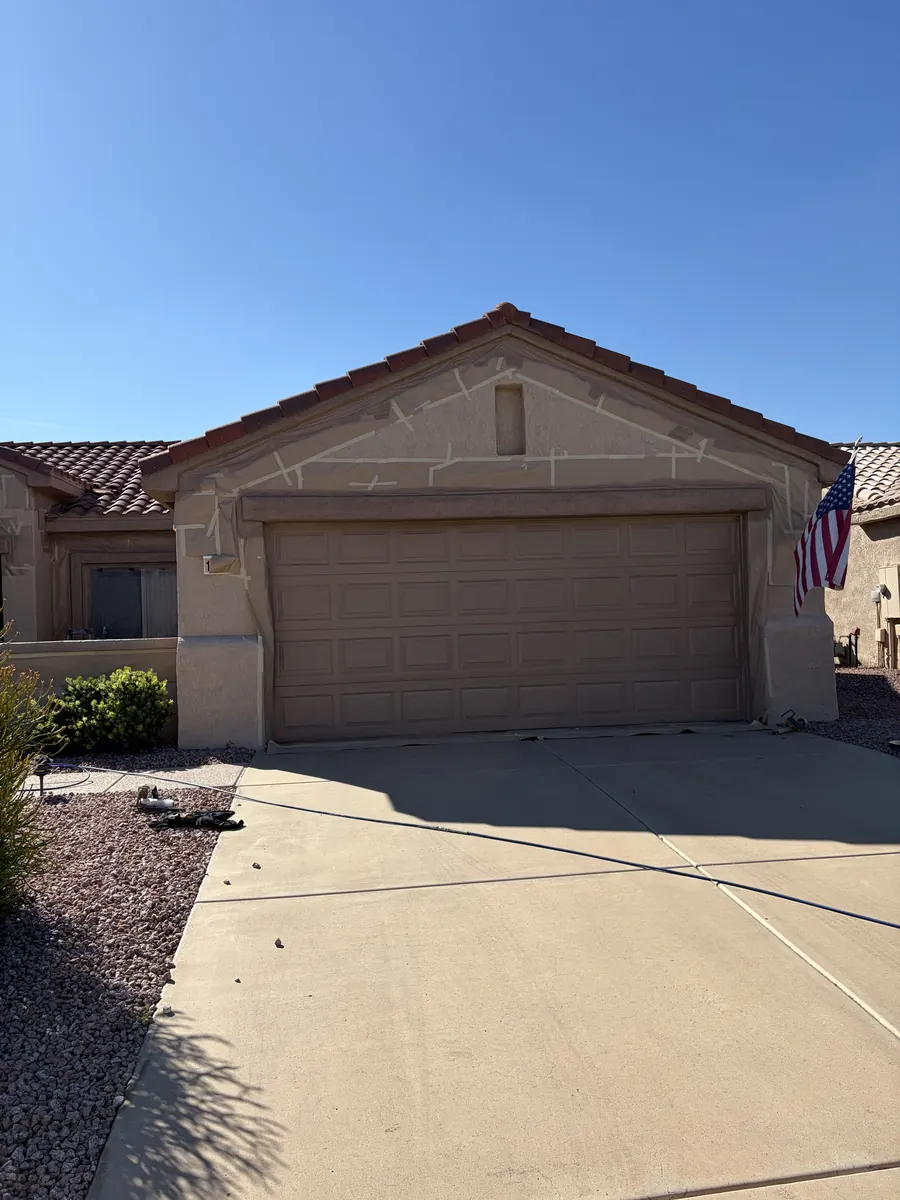
Dust, monsoon splash and a beige-backed white
Every house in the desert collects fine tan dust, and monsoon storms throw dirt up onto the bottom foot or so of the walls. On a stark white that band shows quickly. On Divine White the dust is close to the paint's own tone, so the walls look clean for longer between washings.
The same logic applies to block walls, patio posts and garage doors that pick up dirt from sprinklers and tires. If you want the look of a white house without the upkeep of a bright one, this is the kind of white that makes sense.
Trim choices: Pure White and the listed coordinates
Sherwin-Williams lists Pure White (SW 7005), SW 9169 and SW 2740 as coordinating colors for Divine White. Pure White is the natural trim partner. With an LRV near 84 and a nearly flat spread of 237, 236, 230, it reads whiter than Divine White, so window trim, fascia and doors look crisp without the jump to a cold white.
For more definition, skip white trim entirely and frame Divine White with a deeper color. A warm taupe or a bronze on fascia, garage doors and window surrounds gives the facade a clear outline, and black or dark bronze window frames already do much of that work on newer homes.
Divine White room by room
- North-facing rooms: the beige holds the color back from going gray, which is the main reason to choose a warm white for a cool room.
- South-facing rooms: close to the chip, a calm white with a sandy edge.
- East-facing rooms: bright and fresh in the morning, more linen-like by evening.
- West-facing rooms: the late sun adds a golden cast; a flat ceiling in Pure White keeps the room from feeling yellow.
- Hallways and open plans: one wall color that looks consistent from room to room.
Floors and finishes it gets along with
Divine White is kind to the warm materials that show up in many West Valley homes: travertine, saltillo and other terracotta tile, honey oak cabinets, and stone fireplaces. A cool white beside those finishes can make them look orange. A beige-backed white bridges them instead.
It also works with newer gray wood-look tile, though the pairing is softer and less crisp. If your home is mostly cool grays, black and chrome, a grayer white like Shoji White or a cleaner one like Pure White will look sharper.
What an LRV of about 72 means in July
LRV is the share of visible light a surface reflects. At roughly 72 percent, Divine White keeps a sunny stucco wall far cooler than a tan or gray body color would, and only a little warmer than a bright white. That makes it a practical whole-house color for west elevations that take the full afternoon sun.
Off-whites also hide UV fading well. The tint is light, so as the south and west walls age they drift only slightly, and the change is hard to spot from the street. Chalking and dirt are more likely to be what tells you it is time to repaint.
Sampling and applying Divine White
On stucco we use two coats of Sherwin-Williams Emerald Exterior, sprayed and back-rolled, with Loxon masonry primer on any bare or patched areas. Inside, low-VOC Emerald Interior in eggshell suits living spaces and satin suits kitchens and baths.
- Paint two large samples: one on your sunniest wall and one under a covered patio or entry.
- Hold your trim white against both so you see the real contrast.
- Check the samples beside your roof tile, pavers and any stone.
- If an HOA must approve the color, get that approval before we schedule the work.
Frequently asked questions
- Is Divine White a true white or an off-white?
- It is an off-white. Its blue value sits 25 points below its red, which gives it a beige base, so it reads as a warm white rather than a clean, neutral one.
- Does Divine White look yellow?
- Not usually. It has less yellow than Antique White because its blue value is higher. In strong late-afternoon light it can turn a little golden, as most warm whites do.
- What trim color goes with Divine White?
- Pure White (SW 7005), one of Sherwin-Williams' listed coordinating colors, is the simplest choice for crisp trim. A warm taupe or a bronze gives more contrast if you want the trim to stand out.
- Is Divine White too bright for a stucco house in Arizona?
- No. With a calculated LRV of about 72 it is noticeably softer than the brightest whites, so a full facade in sun reads clean without hard glare.
- Will Divine White show dirt on the outside of my house?
- Less than a bright white. Desert dust and monsoon splash are close to its beige base, so the lower walls stay presentable longer, though they still benefit from an occasional rinse.
- Can I use Divine White on walls and trim in the same room?
- Yes, in different sheens. Eggshell walls with semi-gloss trim in the same color give a soft, tone-on-tone look that suits warm, traditional rooms.