Paint color · Sherwin-Williams tan
Nomadic Desert (SW 6107): A Warm Tan Built for Dusty Desert Walls
Published
Nomadic Desert (SW 6107) is a warm, mid-tone tan with a soft peach lean, close to the color of dry desert soil. It works well as a stucco body color and on block and courtyard walls, where its depth hides dust and splash marks that a light color would show within weeks.
Its hex is #C7B198, and its LRV calculates to about 46 from the RGB values, right in the middle of the scale. That middle position brings real benefits and one real cost, heat, so both are covered below along with scheme ideas and testing tips.
Color swatch: Nomadic Desert SW 6107, #C7B198
| Code | SW 6107 |
|---|---|
| Hex | #C7B198 |
| RGB | 199, 177, 152 |
| LRV | About 46 (calculated from RGB, not Sherwin-Williams' published figure) |
| Color family | Warm mid-tone tan; the Sherwin-Williams color page places it in the orange family |
Why it lands in the orange family
Nomadic Desert's channels are 199 red, 177 green and 152 blue. Red leads green by 22 points and green leads blue by 25. When red pulls ahead of green that clearly, a tan picks up a peach or apricot cast instead of reading as a plain sandy beige, and that is why Sherwin-Williams' color page groups it with the oranges.
On a wall it does not look orange. It looks like a warm, earthy tan. The peach lean shows most at sunrise and sunset and next to cool grays, and least at midday when the sun flattens it.
A body color that forgives dust
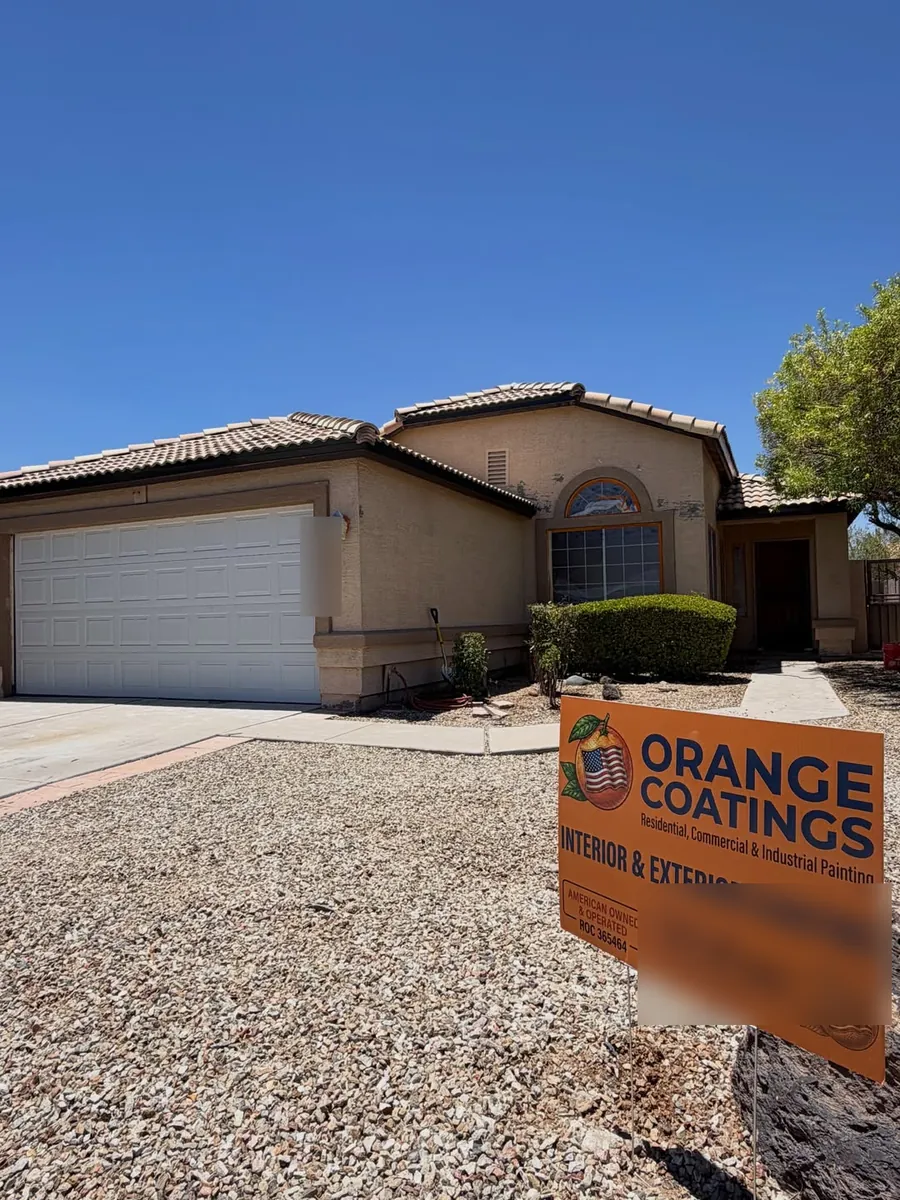
West Valley homes get a fine coat of dust after every windy day and a muddy splash line after each monsoon storm. On a light off-white that grime shows immediately. A mid-tone tan close to the color of the dirt itself keeps a house looking clean much longer between washes.
It also blends into gravel yards, decomposed granite and desert plantings, so the house looks settled into its lot rather than stark against it.
A three-color scheme from one family
Sherwin-Williams lists Divine White (SW 6105), Kilim Beige (SW 6106) and SW 6319 as coordinating colors. The first two step up in lightness from Nomadic Desert, which makes a ready-made tonal scheme.
- Body: Nomadic Desert for the main stucco walls.
- Pop-outs, columns or the upper story: Kilim Beige, calculated at an LRV of about 57, one clear step lighter.
- Fascia and window surrounds: Divine White for a soft, warm outline.
- Front door: a deep warm brown or bronze so the entry still reads as the focal point.
Block walls, courtyards and parapets
Backyard block walls take irrigation overspray, mineral deposits and soil splash at the base. A tan this deep disguises all three. It is also a common choice for matching a perimeter wall to a tan house so the yard reads as one piece.
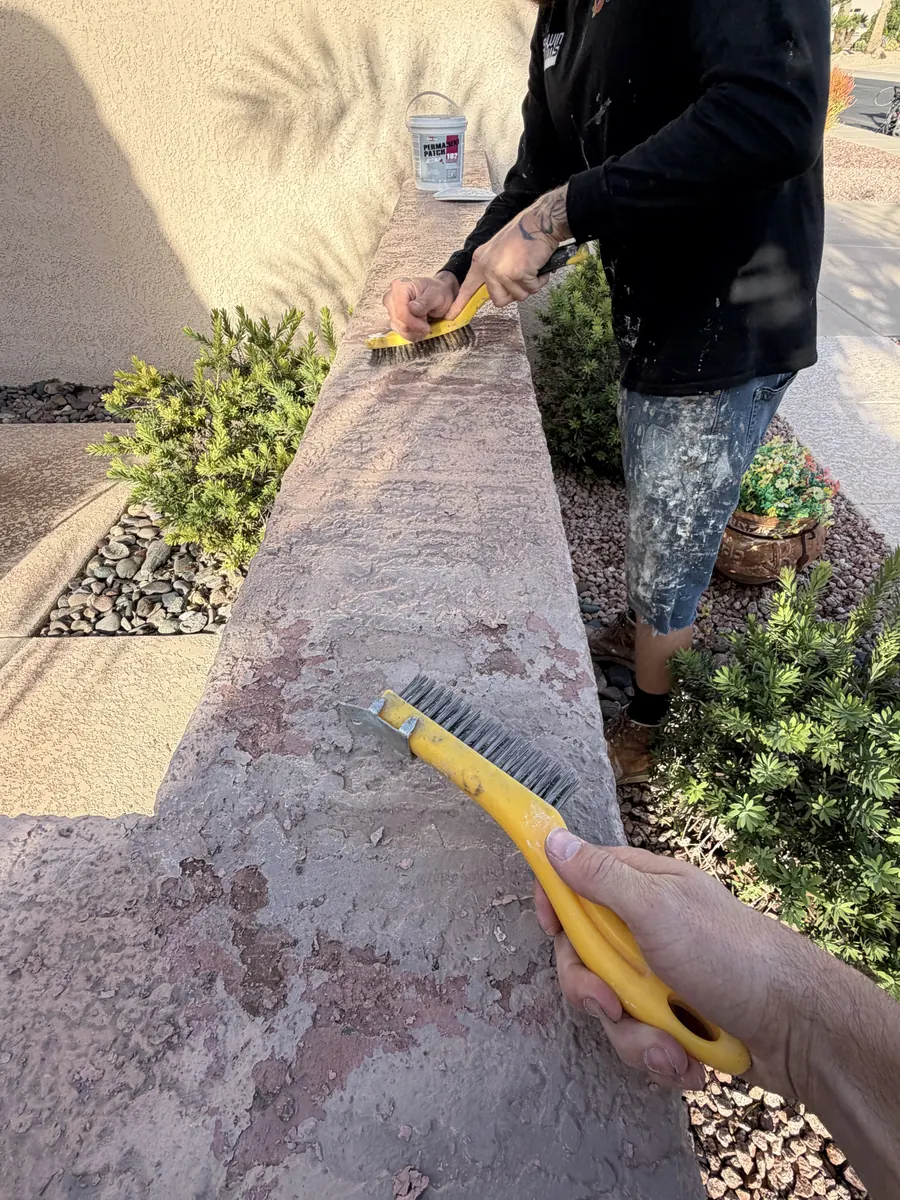
Block needs its own prep. Wire-brush loose paint and efflorescence, let new block cure, and prime bare areas before the finish coats. The same color on block and on stucco can look slightly different because block is more porous and has a coarser face, so sample it on both.
Heat and fading at an LRV of 46
A wall at this level absorbs a little more than half of the visible light that reaches it. On a west elevation in July, a Nomadic Desert wall will run noticeably hotter to the touch than one in an off-white, though nowhere near as hot as a brown or charcoal. Inside, that heat matters less than insulation and windows, but it does put more stress on the paint film over the years.
Mid-tones carry more tint than whites, so fading is something to plan for. The sunny west and south walls will lighten faster than the north side. That is why a touch-up years later can look patchy, and why repainting whole elevations gives a better result than spot work.
Check it against your roof tile and stone
- Terracotta and brown tile: the warm peach lean lines up well and the house looks cohesive.
- Gray or charcoal concrete tile: the contrast with a peachy tan can look mismatched; a greige may suit better.
- Stone veneer: hold a sample against the stone, since many veneers carry pink or gray that can clash with peach.
- Pavers and driveway coatings: tan-family pavers blend; gray pavers sharpen the peach note.
Inside the house
Indoors, Nomadic Desert is deep enough that it changes a room's mood. In west-facing rooms afternoon sun pushes it toward apricot. North light cools it to a muted tan.
It tends to work best on one wall, in a den or office, or below a chair rail, paired with a lighter white trim, rather than throughout an open floor plan. For interiors we use Sherwin-Williams Emerald Interior, a low-VOC line, in eggshell for walls.
Testing a mid-tone tan
- Ask whether your HOA allows the color as a body color, or only as an accent, before you sample.
- Paint large samples on a sunny wall and a shaded wall, plus a patch on any block wall you plan to match.
- View them in the morning, at midday and at dusk beside your roof tile.
- On the job, bare or patched stucco gets Loxon masonry primer, then two coats of Emerald Exterior, sprayed and back-rolled.
Frequently asked questions
- Is Nomadic Desert orange?
- Not on a wall. It is a warm tan whose red channel leads the others, which gives it a soft peach lean. Sherwin-Williams places it in its orange family for that reason, but most people describe it simply as a warm tan.
- Is Nomadic Desert darker than Kilim Beige?
- Yes. Our calculated LRV is about 46 for Nomadic Desert and about 57 for Kilim Beige (SW 6106), so Kilim Beige is a clear step lighter and works well on pop-outs over a Nomadic Desert body.
- Does Nomadic Desert hide dirt on a stucco house?
- Better than most light colors. Its depth is close to the color of desert dust and soil, so dust film and the splash line along the base of the walls show far less.
- Will Nomadic Desert make my house hotter?
- The wall surface will run warmer than a light off-white because it absorbs more sunlight. It stays far cooler than a dark brown or gray, and insulation has more effect on indoor temperature than paint color.
- What trim color goes with Nomadic Desert?
- Divine White (SW 6105), one of its listed coordinating colors, gives a soft warm outline. Kilim Beige (SW 6106) can serve as a middle tone on pop-outs or columns.
- Does Nomadic Desert work with a gray tile roof?
- It can clash, because the peach lean in the tan stands out against cool gray. Test a large sample against the roof before you commit.